

 | English Issue, December 2002 | |||
| Previous page | Contents | Next page | ORDER FORM | |
Solutions of advanced problems A
A. 269. A circular hole is to be completely covered with two square boards. The sides of the squares are 1 metre. In what interval may the diameter of the hole vary?
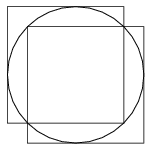
Figure 1
It is easy to see that a hole of radius \(\displaystyle 2-\sqrt2\) (and all smaller holes) can be covered by two unit squares, see Figure 1.
We will prove that if a unit square covers at least half of the perimeter of a circle of radius r, then \(\displaystyle r\le2-\sqrt2\). This implies that the diameter of the hole cannot exceed
\(\displaystyle 4-2\sqrt2\approx1.17~\rm metre. \)
Let K be a circle of radius r, and N be a unit square, which covers at least the half of K. If r\(\displaystyle \ge\)1/2, then N can be translated such that each side of N or its extension has at least one common point with K and the covered part of the curve is increasing, see Figure 2.
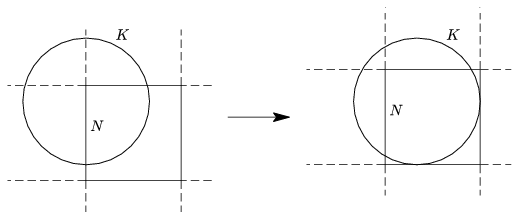
Figure 2
So, it can be assumed that r>1/2 and (the extension of) each side of N has a common point with K.
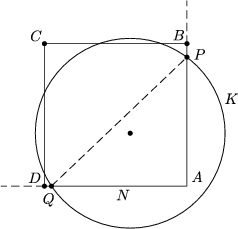
First, assume that a vertex of N is inside K. Let the vertices of N be A, B, C, D and suppose that A is inside K. Denote the intersection of K and the half-lines AB and AD by P and Q, respectively. (Figure 3.)
Because PAQ\(\displaystyle \angle\)=90o, the centre of K and vertex A are on the same side of line PQ. This implies that the uncovered arc PQ is longer than the half of K. This is a contradiction, thus this case is impossible.
We are left to deal with the case when there are no vertices of N inside K and each side or its extension has a common point with K. It is easy to check that these common points cannot be on the extension of the sides of N; they must lie on the perimeter of N.
 |  |
| Figure 3 | Figure 4 |
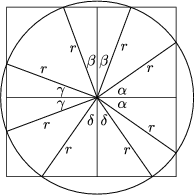
Denote by \(\displaystyle \alpha\), \(\displaystyle \beta\), \(\displaystyle \gamma\) and \(\displaystyle \delta\) the angles drawn on Figure 4.
The total of the uncovered arcs is at most the half of K, so \(\displaystyle \alpha\)+\(\displaystyle \beta\)+\(\displaystyle \gamma\)+\(\displaystyle \delta\) 90o. By symmetry, it can be assumed that
  +
+ 45o.
45o.
As can be read from the Figure, r(cos +cos )=r(cos  +cos
+cos  )=1. The concavity of the cosine function yields

and hence 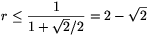 .
.
Thus, the radius of the hole can be at most  ; its diameter can be at most
  metre.