

 Problem A. 912. (September 2025)
A. 912. Let \(\displaystyle ABC \) be a triangle, and let the symmedian through \(\displaystyle A\) intersect the circumcircle of the triangle at a second point \(\displaystyle A'\). Prove that the following three points lie on a line:
- the reflection of point \(\displaystyle A\) over the line \(\displaystyle BC\);
- the inverse image of point \(\displaystyle A\) under inversion with respect to the Feuerbach circle of triangle \(\displaystyle ABC\);
- the midpoint of the chord \(\displaystyle AA'\).
Proposed by: Ábel Szakács, Budapest
(7 pont)
Deadline expired on October 10, 2025.
Let us introduce some notation: let \(\displaystyle D,E,F\) be the midpoints of sides \(\displaystyle BC,CA,AB\), respectively. Denote by \(\displaystyle O\) the circumcenter of triangle \(\displaystyle ABC\), by \(\displaystyle T\) the reflection of \(\displaystyle A\) across line \(\displaystyle BC\), by \(\displaystyle X\) the inverse of \(\displaystyle A\) with respect to the nine-point circle, by \(\displaystyle D_A\) the midpoint of \(\displaystyle AA'\), by \(\displaystyle K\) the circumcenter of triangle \(\displaystyle BOC\), and by \(\displaystyle P\) the intersection point of the tangents to \(\displaystyle (ABC)\) at \(\displaystyle B\) and \(\displaystyle C\).
We can immediately observe that \(\displaystyle P\) lies on circle \(\displaystyle (BOC)\), and moreover \(\displaystyle OP\) is a diameter of this circle, since the tangents imply that points \(\displaystyle B\) and \(\displaystyle C\) are seen at right angle from segment \(\displaystyle OP\). Also, \(\displaystyle D_A\) lies on this circle, because \(\displaystyle P\) lies on the symmedian, and \(\displaystyle OD_A \perp AA'\) (since \(\displaystyle D_A\) is the midpoint of the chord).
Now consider the composition of the inversion centered at \(\displaystyle A\) with radius \(\displaystyle r := \sqrt{\dfrac{|AB|\cdot|AC|}{2}}\) and the reflection in the \(\displaystyle A\)-angle bisector. For every point \(\displaystyle K\), denote its image under this transformation by \(\displaystyle K^*\). Note that this transformation is an involution, i.e. \(\displaystyle (Q^*)^* = Q\). We can immediately see that \(\displaystyle B^* = E\) and \(\displaystyle C^* = F\). Let us prove that \(\displaystyle D_A^* = D\). The point \(\displaystyle A'\) lies on circle \(\displaystyle (ABC)\), whose image is the midline \(\displaystyle EF\). Since the \(\displaystyle A\)-symmedian maps to the median \(\displaystyle AD\), the image of \(\displaystyle A'\) is the intersection of the midline \(\displaystyle EF\) and the median, which is in fact the midpoint of \(\displaystyle AD\). On the other hand, by inversion, the image of \(\displaystyle A'\) is the midpoint of \(\displaystyle AD_A^*\), since
\(\displaystyle |AD_A^*| = \frac{r^2}{|AD_A|} = \frac{r^2}{\tfrac{|AA'|}{2}} = 2 \cdot |AA'^*|. \)
Thus we have shown that \(\displaystyle D_A^* = D\). Moreover, it follows that the image of the Feuerbach circle \(\displaystyle (DEF)\) is precisely the circle \(\displaystyle (DABC)\). Since \(\displaystyle O\) lies on this circle, its image \(\displaystyle O^*\) lies on the Feuerbach circle. The circle \(\displaystyle (AEF)\) also passes through \(\displaystyle O\), so its image, i.e. the line \(\displaystyle BC\), also passes through \(\displaystyle O^*\). Hence \(\displaystyle O^*\) must be the foot of the altitude from \(\displaystyle A\). Since \(\displaystyle O^*\) is the midpoint of \(\displaystyle AT\), similarly \(\displaystyle T^*\) is the midpoint of segment \(\displaystyle AO\). Finally, what is \(\displaystyle X^*\)? Since \(\displaystyle A\) and \(\displaystyle X\) are inverse points with respect to the Feuerbach circle, after the transformation the point at infinity and \(\displaystyle X^*\) must be inverses with respect to the circle \(\displaystyle (BD_AOCP)\) (since this is the image of the Feuerbach circle). Therefore \(\displaystyle X^*\) is the center of this circle, i.e. the midpoint of diameter \(\displaystyle OP\).
Let us now return to the problem. We need to prove that points \(\displaystyle T,D_A,X\) are collinear. After the transformation, this is equivalent to proving that points \(\displaystyle A,T^*,D,X^*\) are concyclic. Since \(\displaystyle AT^* \cap DX^* = O\), it suffices to show that \(\displaystyle OD \cdot OX^* = OT^* \cdot OA.\) But \(\displaystyle OA = 2OT^*\) and \(\displaystyle OP = 2OX^*\), so this is equivalent to \(\displaystyle OA^2 = OD \cdot OP\), which exactly means that line \(\displaystyle OA\) is tangent to circle \(\displaystyle (ADP)\). This can be readily verified. The claim is equivalent to \(\displaystyle \angle DAO = \angle DPA.\) By isogonality we have \(\displaystyle \angle DAO = \angle O^*AP\), and by alternate angles we obtain \(\displaystyle \angle O^*AP = \angle DPA\). This completes the proof.
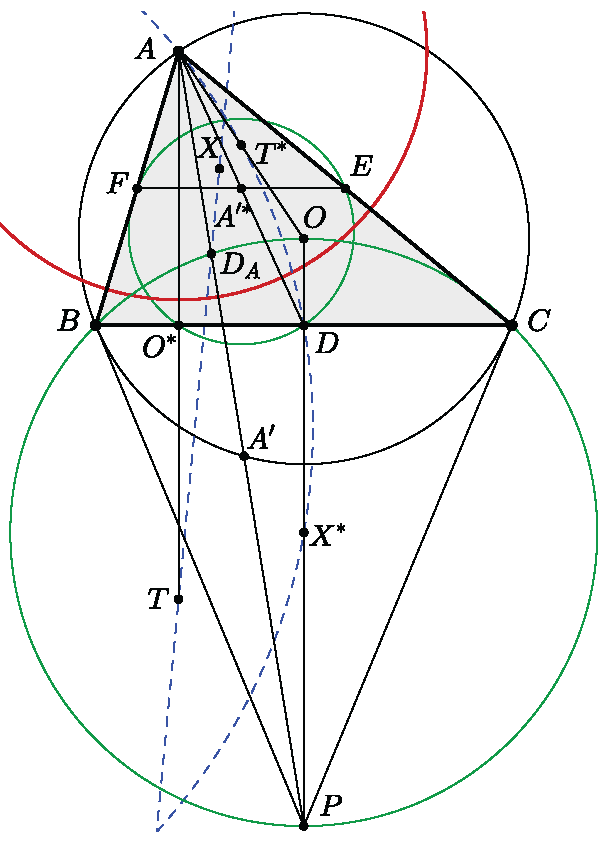
Remark. \(\displaystyle D_A\) is the Dumpty point corresponding to vertex \(\displaystyle A\).
Statistics:
20 students sent a solution. 7 points: Ali Richárd, Bodor Mátyás, Bui Thuy-Trang Nikolett, Diaconescu Tashi, Forrai Boldizsár, Gyenes Károly, Li Mingdao, Liu Zhe, Szakács Ábel, Vigh 279 Zalán, Vincze Marcell, Xiaoyi Mo. 6 points: Prohászka Bulcsú, Vödrös Dániel László. 5 points: 1 student. 4 points: 1 student. 3 points: 1 student. 0 point: 2 students. Unfair, not evaluated: 1 solutions.
Problems in Mathematics of KöMaL, September 2025