

 Problem A. 925. (January 2026)
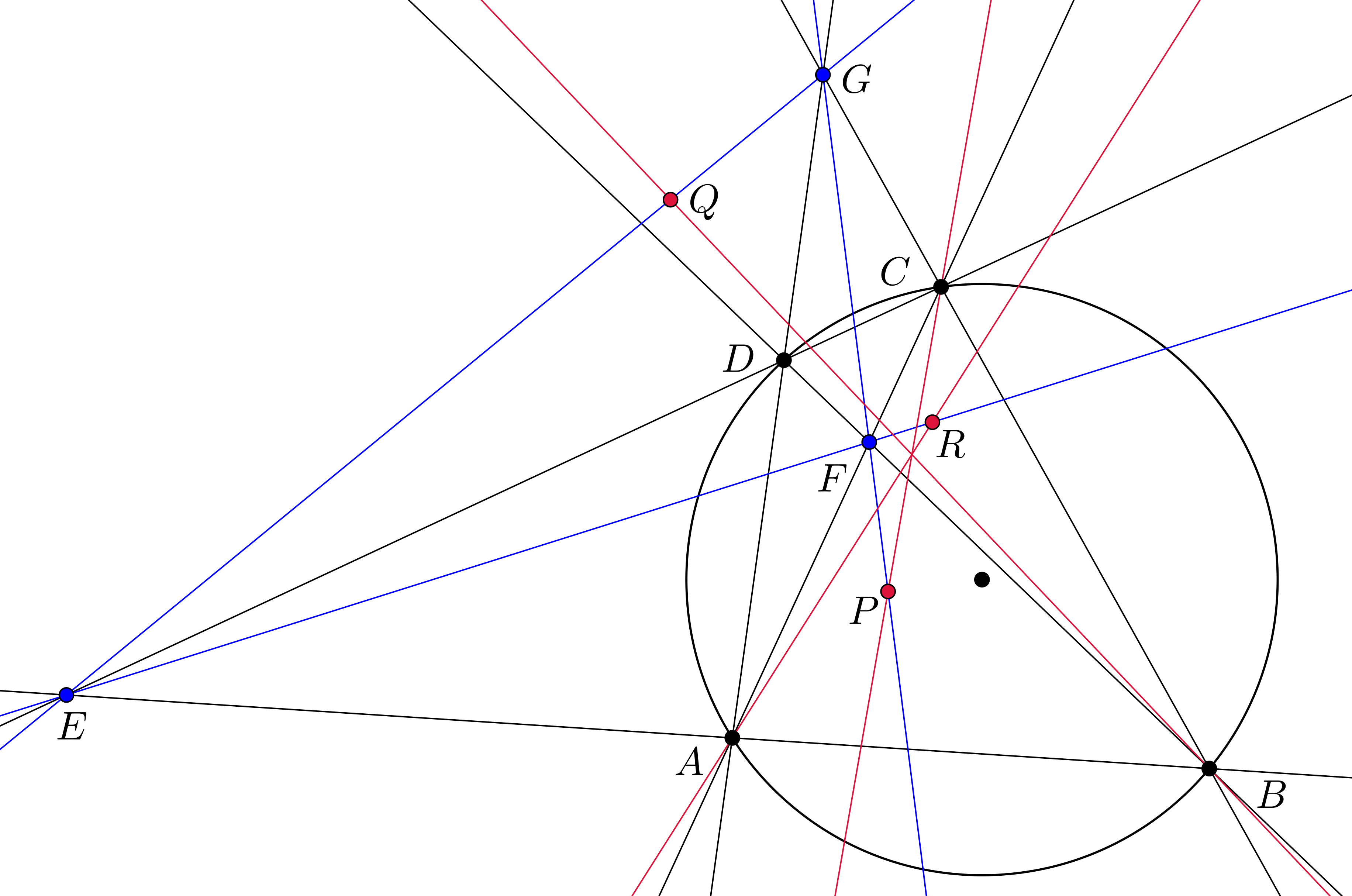
A. 925. Call four points to be in general position if they are pairwise distinct, no three of them are collinear, and no two of the six lines determined by them are parallel. Let \(\displaystyle A\), \(\displaystyle B\), \(\displaystyle C\), \(\displaystyle D\) be points in general position lying on a circle. Let \(\displaystyle E\) be the intersection point of lines \(\displaystyle AB\) and \(\displaystyle CD\), let \(\displaystyle F\) be the intersection point of lines \(\displaystyle AC\) and \(\displaystyle BD\), and let \(\displaystyle G\) be the intersection point of lines \(\displaystyle AD\) and \(\displaystyle BC\). In triangle \(\displaystyle EFG\), denote by \(\displaystyle P\), \(\displaystyle Q\), and \(\displaystyle R\) the feet of the altitudes corresponding to the vertices \(\displaystyle E\), \(\displaystyle F\), and \(\displaystyle G\), respectively.
a) Show that the triples of lines \(\displaystyle AR\)–\(\displaystyle BQ\)–\(\displaystyle CP\), \(\displaystyle AQ\)–\(\displaystyle BR\)–\(\displaystyle DP\), \(\displaystyle AP\)–\(\displaystyle CR\)–\(\displaystyle DQ\), and \(\displaystyle BP\)–\(\displaystyle CQ\)–\(\displaystyle DR\) are either concurrent or parallel.
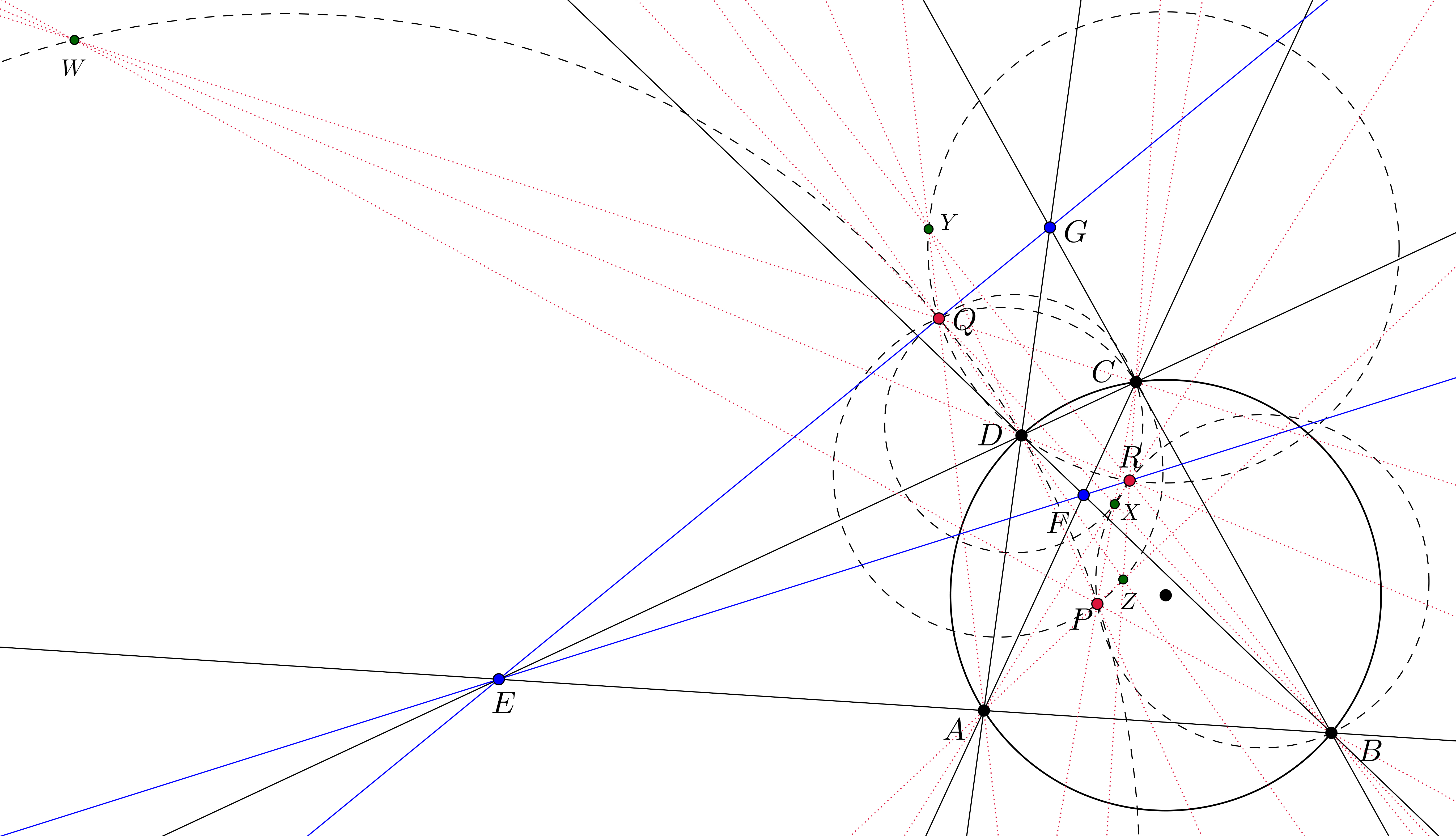
b) Suppose that each of the four triples of lines is concurrent, and denote their points of concurrency by \(\displaystyle X\), \(\displaystyle Y\), \(\displaystyle Z\), and \(\displaystyle W\), respectively. Assume further that these points are in general position. Prove that the Miquel points of quadrilaterals \(\displaystyle XWYZ\), \(\displaystyle XYZW\), and \(\displaystyle XZWY\) are precisely the points \(\displaystyle P\), \(\displaystyle Q\), and \(\displaystyle R\).
Proposed by Boldizsár Varga, Verőce and Áron Bán-Szabó, Palaiseau
(7 pont)
Deadline expired on February 10, 2026.
Solution. Throughout the proof we will work with directed angles. By logical symmetry, for part a) it is enough to show that the lines \(\displaystyle AR,BQ,CP\) meet at a point \(\displaystyle X\).
We will prove the concurrency by inversion. Let us invert with respect to a circle centered at \(\displaystyle B\). Under the inversion, we denote the image of any point \(\displaystyle K\) by \(\displaystyle K^*\). From the construction in the figure we immediately obtain that the points \(\displaystyle A^*,D^*,C^*\) are collinear (since \(\displaystyle ABCD\) is a cyclic quadrilateral), \(\displaystyle E^*\) is the second intersection point of the line \(\displaystyle BA^*\) and the circle \(\displaystyle (BC^*D^*)\), \(\displaystyle F^*\) is the second intersection point of the line \(\displaystyle BD^*\) and the circle \(\displaystyle (BA^*C^*)\), and \(\displaystyle G^*\) is the second intersection point of the line \(\displaystyle BC^*\) and the circle \(\displaystyle (BA^*D^*)\). What are the points \(\displaystyle P^*,Q^*,R^*\)? Brocard's theorem states that with respect to the circle \(\displaystyle (ABCD)\), the polar of each vertex of triangle \(\displaystyle EFG\) is the opposite sideline. Hence the foot of the altitude is precisely the inverse of the corresponding vertex with respect to this circle. The inverse property is preserved after inversion. Therefore the point pairs \(\displaystyle E^*-P^*\), \(\displaystyle F^*-Q^*\), \(\displaystyle G^*-R^*\) are still inverse to each other, that is, they are reflections with respect to the image of the circle \(\displaystyle (ABCD)\), which is exactly the line \(\displaystyle A^*D^*C^*\). In other words, \(\displaystyle P^*,Q^*,R^*\) are the reflections of \(\displaystyle E^*,F^*,G^*\) across the line \(\displaystyle A^*D^*C^*\), and it remains to show that the circles \(\displaystyle (BA^*R^*)\), \(\displaystyle (BC^*P^*)\) and the line \(\displaystyle BQ^*\) pass through a point \(\displaystyle X\neq B\).

Define \(\displaystyle X\) as the intersection point of the lines \(\displaystyle BQ^*\) and \(\displaystyle P^*R^*\), and we will show that this is the desired point. First we show that the points \(\displaystyle A^*,F^*,R^*\) are collinear. Indeed,
\(\displaystyle R^*A^*D^*\sphericalangle=-G^*A^*D^*\sphericalangle=-G^*BD^*\sphericalangle=-C^*BF^*\sphericalangle=-C^*A^*F^*\sphericalangle=F^*A^*D^*,\)
where the first equality holds because of the reflection, and the others hold because of cyclic quadrilaterals. Similarly, one can show that the triples \(\displaystyle A^*-G^*-Q^*\), \(\displaystyle C^*-E^*-Q^*\), \(\displaystyle C^*-F^*-P^*\), \(\displaystyle D^*-E^*-R^*\), \(\displaystyle D^*-G^*-P^*\) are collinear. (Not all of these will be needed, but this completes the figure.) Now we are ready to show that the points \(\displaystyle A^*,B,R^*,X\) are concyclic:
\(\displaystyle XR^*A^*\sphericalangle=P^*R^*A^*\sphericalangle=-E^*G^*A^*\sphericalangle=-E^*G^*Q^*\sphericalangle=-E^*BQ^*\sphericalangle=XBA^*\sphericalangle,\)
where again we used the reflection property, and also the inscribed angle theorem in a cyclic quadrilateral. Of course, similarly one can show that the points \(\displaystyle C^*,B,P^*,X\) are also concyclic. This proves part a).
Let us move on to part b). Again, by logical symmetry it is enough to show that \(\displaystyle Q\) is the Miquel point of \(\displaystyle XYZW\). Looking back at the proof of part a), after inverting back we see that the points \(\displaystyle B,P,R,X\) are concyclic. Similarly, we can see that the points \(\displaystyle D,P,Q,W\) are concyclic, and also the points \(\displaystyle D,R,Q,Y\) are concyclic. Since \(\displaystyle D\) is the intersection point of the lines \(\displaystyle PY\) and \(\displaystyle RW\), \(\displaystyle Q\) is the Miquel point of the quadrilateral \(\displaystyle PYRW\). Therefore there exists a spiral similarity \(\displaystyle \varphi\) centered at \(\displaystyle Q\) which maps \(\displaystyle W\) to \(\displaystyle P\), while it maps \(\displaystyle R\) to \(\displaystyle Y\). Similarly, the points \(\displaystyle C,P,Q,Z\) and \(\displaystyle C,Q,R,X\) are also concyclic, hence \(\displaystyle Q\) is the Miquel point of the quadrilateral \(\displaystyle PZRX\), which implies that there exists a spiral similarity \(\displaystyle \psi\) centered at \(\displaystyle Q\) that maps \(\displaystyle P\) to \(\displaystyle Z\) and \(\displaystyle X\) to \(\displaystyle R\). Notice that under \(\displaystyle \varphi\circ \psi\) we have \(\displaystyle X\to R\to Y\), while under \(\displaystyle \psi\circ \varphi\) we have \(\displaystyle W\to P\to Z\). However, the centers of \(\displaystyle \varphi\) and \(\displaystyle \psi\) coincide, so we have \(\displaystyle \varphi\circ \psi=\psi\circ\varphi\). And this spiral similarity maps \(\displaystyle X\) to \(\displaystyle Y\) and \(\displaystyle W\) to \(\displaystyle Z\). Its center is \(\displaystyle Q\), hence indeed \(\displaystyle Q\) is the Miquel point of \(\displaystyle XYZW\).
Statistics:
14 students sent a solution. 7 points: Bodor Mátyás, Bui Thuy-Trang Nikolett, Diaconescu Tashi, Forrai Boldizsár, Kis Ágoston (5 students). 4 points: 1 student. 3 points: 4 students. 2 points: 2 students. 0 points: 2 students.
Problems in Mathematics of KöMaL, January 2026