

 Problem A. 927. (February 2026)
A. 927. Let \(\displaystyle ABCDEF\) be a bicentric hexagon, that is a hexagon which is both cyclic and tangential. Assume that there exists a point \(\displaystyle P\) such that line \(\displaystyle AP\) is perpendicular to line \(\displaystyle BF\), \(\displaystyle CP\) is perpendicular to \(\displaystyle BD\), and \(\displaystyle EP\) is perpendicular to \(\displaystyle DF\). Prove that there are two opposite sides of the hexagon whose sum is equal to the circumdiameter.
Proposed by Andrei Chirita, Cambridge
(7 pont)
Deadline expired on March 10, 2026.
Solution. We shall prove that the hexagon is symmetric to one of its long diagonals.
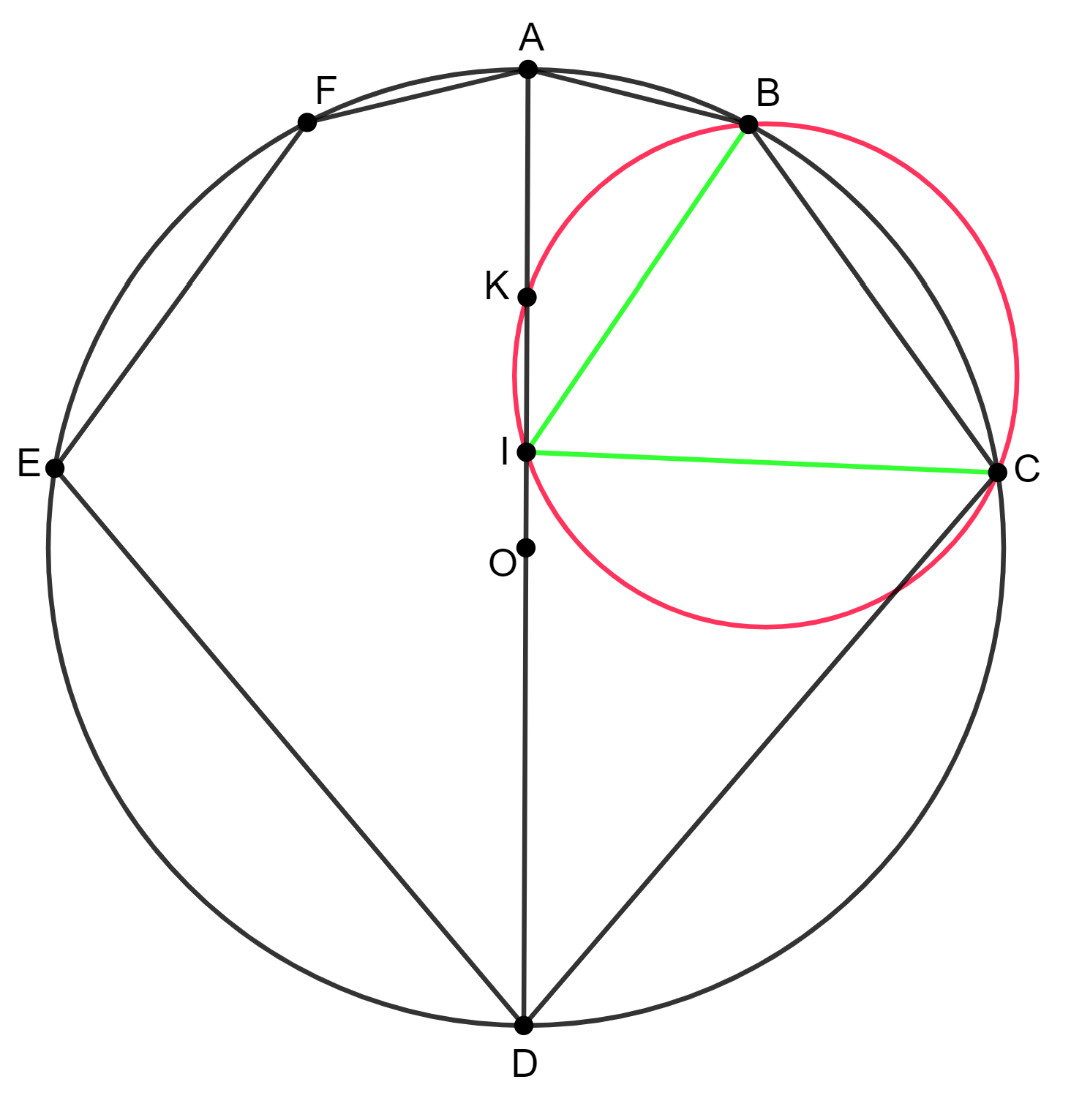
First we show that if a bicentric hexagon is symmetric to its diagonal \(\displaystyle AD\) then \(\displaystyle AB+DE=2R\). Denote by \(\displaystyle I\) the incenter of the hexagon, then \(\displaystyle I\) lies on \(\displaystyle AD\). Let \(\displaystyle K\) be the second intersection of circle \(\displaystyle BCI\) and line \(\displaystyle AD\). By simple angle chasing \(\displaystyle CKD\sphericalangle=CBI\sphericalangle=\frac12CBA\sphericalangle=\frac12(180^\circ-ADC\sphericalangle)\), and it follows that triangle \(\displaystyle CKD\) is isosceles, \(\displaystyle DC=DK\). It can be obtained similarly that \(\displaystyle AB=AK\), and hence \(\displaystyle AB+DE=AB+DC=DK+AK=2R\), as stated.
Next, we claim that the polynomials \(\displaystyle (x-AB)(x-CD)(x-EF)\) and \(\displaystyle (x-BC)(x-DE)(x-FA)\) are equal. The coefficients of \(\displaystyle x^2\) in these polynomials are equal because \(\displaystyle AB+CD+EF=BC+DE+FA\), since the hexagon has an incircle.
The coefficients of \(\displaystyle x\) are equal if and only if \(\displaystyle AB\cdot CD+CD\cdot EF+EF\cdot AB=BC\cdot DE+DE\cdot FA+FA\cdot BC\). In quadrilateral \(\displaystyle ABFP\) the diagonals \(\displaystyle AP\) and \(\displaystyle BF\) are perpendicular, so \(\displaystyle BP^2-FP^2=AB^2-FA^2\). Similarly, by \(\displaystyle CP\perp BD\) we have \(\displaystyle DP^2-BP^2=CD^2-BC^2\), and finally \(\displaystyle FP^2-DP^2=EF^2-DE^2\). By summing up these relations we get
\(\displaystyle AB^2-FA^2+CD^2-BC^2+EF^2-DE^2=0, \)
so \(\displaystyle AB^2+CD^2+EF^2=BC^2+DE^2+FA^2\); we obtain
\(\displaystyle AB\cdot CD+CD\cdot EF+EF\cdot AB=\frac12\left((AB+CD+EF)^2-(AB^2+CD^2+EF^2)\right), \)
and analogously
\(\displaystyle BC\cdot DE+DE\cdot FA+FA\cdot BC=\frac12\left((BC+DE+FA)^2-(BC^2+DE^2+FA^2)\right). \)
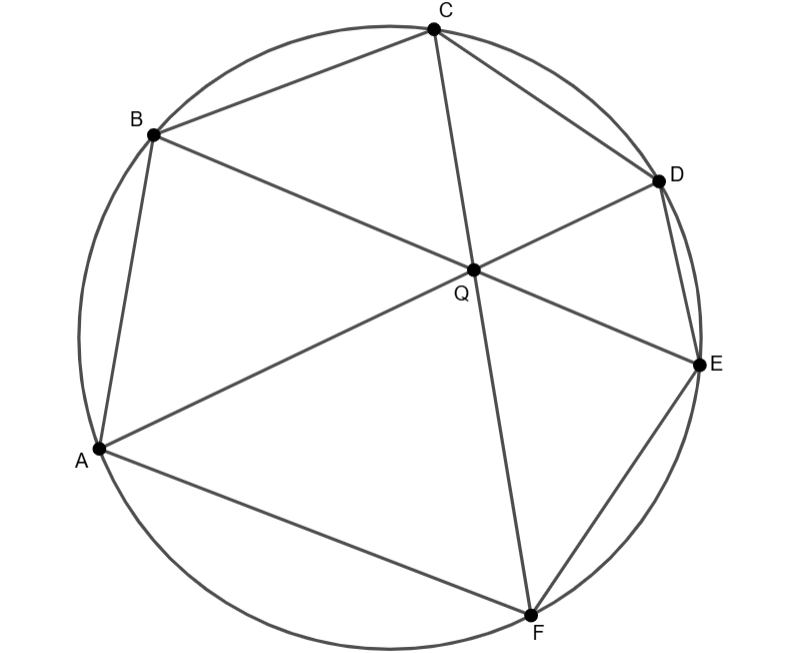
Finally, for the constant terms of the two polynomials we have to verify \(\displaystyle AB\cdot CD\cdot EF=BC\cdot DE\cdot FA\). By Brianchon's theorem, the diagonals \(\displaystyle AD\), \(\displaystyle BE\) and \(\displaystyle CF\) are concurrent, let them meet at \(\displaystyle Q\). Triangles \(\displaystyle ABQ\) and \(\displaystyle EQD\) are similar, so \(\displaystyle AB/DE=AQ/EQ\). Similarly, \(\displaystyle EF/BC=EQ/CQ\) and \(\displaystyle CD/FA=CQ/AQ\). By taking products we get our claim.
By the claim, the two polynomials have the same roots, so distances \(\displaystyle AB\), \(\displaystyle CD\), \(\displaystyle EF\) match \(\displaystyle BC\), \(\displaystyle DE\), \(\displaystyle FA\) in some order.
Case 1: \(\displaystyle AB=BC\), \(\displaystyle CD=DE\) and \(\displaystyle EF=FA\) (the order of side lengths in the hexagon is like \(\displaystyle xxyyzz\)). The bisectors of angles \(\displaystyle \sphericalangle{ABC}\), \(\displaystyle \sphericalangle{CDE}\) and \(\displaystyle \sphericalangle{EFA}\) are diameters in the circumcircle, so the incenter is same as the circumcircle, and the hexagon is regular.
Case 2: \(\displaystyle AB=BC\), \(\displaystyle CD=FA\) and \(\displaystyle EF=DE\) (the order of order is like \(\displaystyle xxyzzy\)). Then the hexagon is symmetric about diagonal \(\displaystyle BE\).
Case 3: \(\displaystyle AB=DE\), \(\displaystyle CD=FA\) and \(\displaystyle EF=BC\) (the order is \(\displaystyle xyzxyz\)). The hexagon centrally symmetric, so the incenter and the circumcenter are the same and the hexagon is regular again.
Statistics:
14 students sent a solution. 7 points: Bodor Mátyás, Bolla Donát Andor, Diaconescu Tashi, Forrai Boldizsár, Li Mingdao, Rajtik Sándor Barnabás, Vigh 279 Zalán, Vincze Marcell (8 students). 6 points: Kis Ágoston (1 student). 2 points: 2 students. 1 point: 1 student. 0 points: 2 students.
Problems in Mathematics of KöMaL, February 2026