

 Problem A. 932. (April 2026)
A. 932. Let \(\displaystyle ABC\) be an acute triangle with orthocenter \(\displaystyle H\). Points \(\displaystyle D\) and \(\displaystyle E\) lie on the lines \(\displaystyle AC\) and \(\displaystyle AB\), respectively, such that the points \(\displaystyle B\), \(\displaystyle C\), \(\displaystyle D\), \(\displaystyle E\) are concyclic, and the line \(\displaystyle DE\) bisects the side \(\displaystyle BC\). Suppose that the lines \(\displaystyle BD\) and \(\displaystyle CE\) meet at \(\displaystyle M\). Prove that the line \(\displaystyle HM\) is perpendicular to the symmedian through \(\displaystyle A\).
Proposed by Áron Bán-Szabó, Palaiseau
(7 pont)
Deadline expired on May 11, 2026.
First solution.
Let \(\displaystyle B_0\) and \(\displaystyle C_0\) be the feet of the altitudes, that is, \(\displaystyle BB_0\perp AC\) and \(\displaystyle CC_0\perp AB\). Let furthermore \(\displaystyle F\) denote the midpoint of side \(\displaystyle BC\), and let \(\displaystyle B_0E\cap C_0D=S\). It is well known that the lines \(\displaystyle FB_0\) and \(\displaystyle FC_0\) are tangent to the circle \(\displaystyle k=(AB_0HC_0)\).
Since in the angle region \(\displaystyle \angle BAC\) the line \(\displaystyle BC\) is antiparallel both to \(\displaystyle DE\) and to \(\displaystyle B_0C_0\), it follows that \(\displaystyle DE\parallel B_0C_0\).
Now consider the hexagon \(\displaystyle B_0B_0AC_0C_0S\). Applying the converse of Pascal's theorem, we obtain that \(\displaystyle S\in k\). On the other hand, applying the Pappus–Pascal theorem to the triples \(\displaystyle B,C_0,E\) and \(\displaystyle C,B_0,D\), it follows that the corresponding intersection points are collinear, hence \(\displaystyle S\in HM\). Therefore \(\displaystyle H,S,M\) are collinear.
Now consider the trapezoid \(\displaystyle EDB_0C_0\). Here \(\displaystyle A\) is the intersection point of the legs, while \(\displaystyle S\) is the intersection point of the diagonals. In a trapezoid, the line joining the intersection point of the legs and the intersection point of the diagonals bisects the bases, hence the line \(\displaystyle AS\) bisects the segment \(\displaystyle B_0C_0\). Thus \(\displaystyle AS\) is a median in triangle \(\displaystyle AB_0C_0\).
Since triangles \(\displaystyle ABC\) and \(\displaystyle AB_0C_0\) are similar, the median of triangle \(\displaystyle AB_0C_0\) corresponds to the symmedian of triangle \(\displaystyle ABC\). Hence \(\displaystyle AS\) is the \(\displaystyle A\)-symmedian of triangle \(\displaystyle ABC\).
Finally, since \(\displaystyle S\in k=(AB_0HC_0)\), Thales' theorem implies that \(\displaystyle AS\perp HS\). Since \(\displaystyle H,S,M\) are collinear, it follows that \(\displaystyle HM\perp AS\). Therefore the line \(\displaystyle HM\) is perpendicular to the \(\displaystyle A\)-symmedian, as desired.

Second solution.
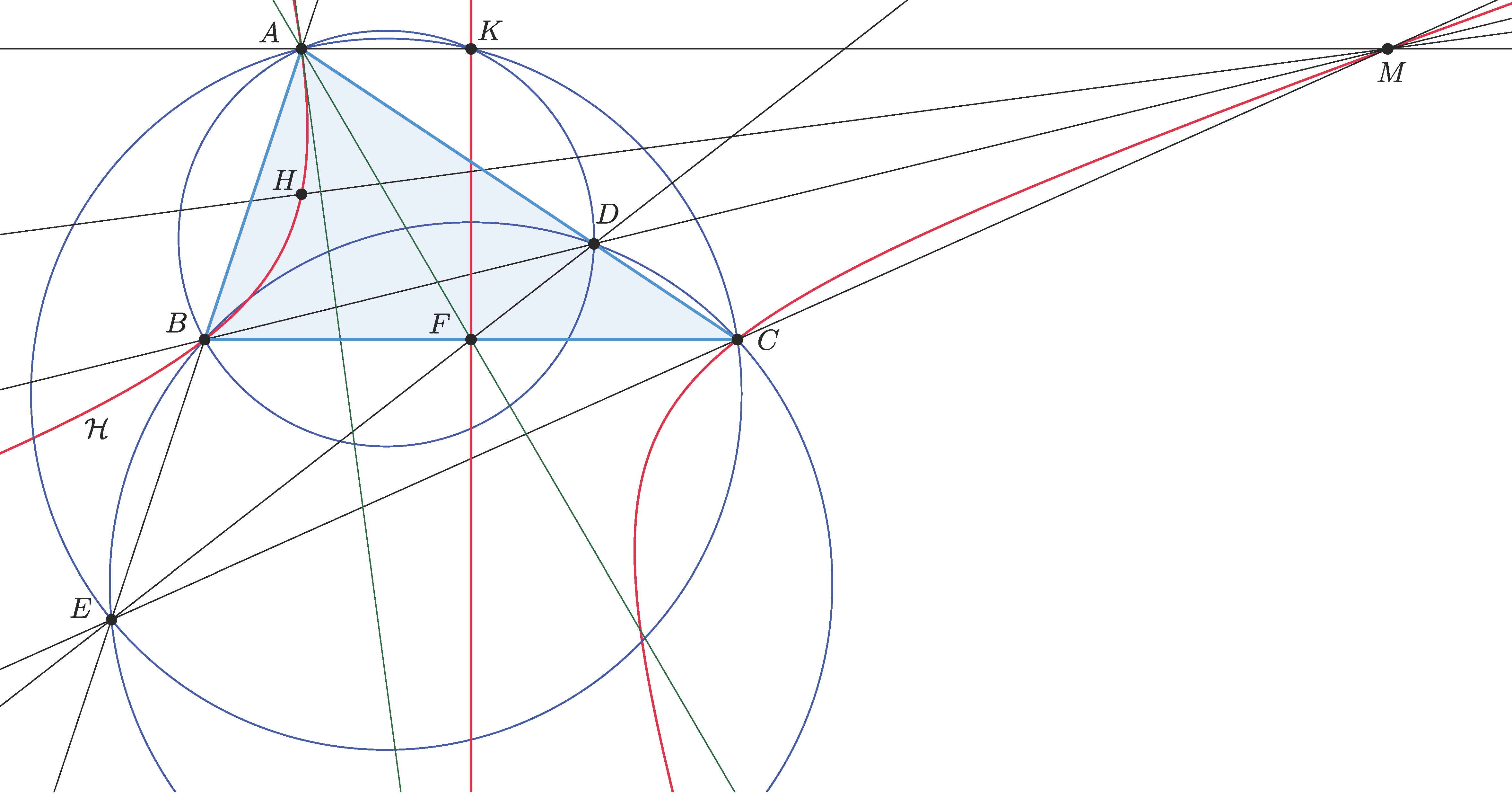
We begin by proving that \(\displaystyle AM\parallel BC\). Let \(\displaystyle K\) denote the Miquel point of quadrilateral \(\displaystyle BECD\), and let \(\displaystyle F\) be the midpoint of side \(\displaystyle BC\). Since \(\displaystyle BECD\) is cyclic, \(\displaystyle K\) is the projection of \(\displaystyle F\) onto \(\displaystyle AM\). Then
\(\displaystyle \angle BKF =90^{\circ}-\angle AKB =90^{\circ}-\angle ADB =90^{\circ}+\angle AEC =90^{\circ}-\angle AKC =\angle CKF, \)
hence in triangle \(\displaystyle KBC\), the median \(\displaystyle KF\) is also an angle bisector. Therefore \(\displaystyle AM\perp FK\perp BC\).
Now consider the isogonal conjugate of the perpendicular bisector of segment \(\displaystyle BC\). This is a rectangular hyperbola (since the circumcenter of triangle \(\displaystyle ABC\) lies on the perpendicular bisector), and it passes through the points \(\displaystyle A,B,C,H\). Denote it by \(\displaystyle \mathcal{H}\). We claim that \(\displaystyle M\) also lies on this hyperbola. Indeed, observe that if \(\displaystyle P\) lies on the perpendicular bisector of \(\displaystyle BC\), then \(\displaystyle \angle PBC=\angle PCB\). After isogonal conjugation this becomes \(\displaystyle \angle P^*BA=\angle P^*CA\) (where \(\displaystyle P^*\) denotes the isogonal conjugate of \(\displaystyle P\)), which by the theorem on inscribed angles is equivalent to saying that the points \(\displaystyle B,C,P^*B\cap AC,P^*C\cap AB\) are concyclic. Since \(\displaystyle B,C,D,E\) are concyclic, it follows that indeed \(\displaystyle M\in\mathcal{H}\).
The next step is to prove that the tangent to \(\displaystyle \mathcal{H}\) at \(\displaystyle A\) is precisely the \(\displaystyle A\)-symmedian. Indeed, after isogonal conjugation, the image of the tangent at \(\displaystyle A\) is a line through \(\displaystyle A\) intersecting the image of \(\displaystyle \mathcal{H}\), namely the perpendicular bisector of \(\displaystyle BC\), at the image of \(\displaystyle A\), that is, at \(\displaystyle F\). But the isogonal conjugate of the median is exactly the symmedian.
Finally, we prove that \(\displaystyle HM\) is perpendicular to the \(\displaystyle A\)-symmedian, that is, to the tangent to \(\displaystyle \mathcal{H}\) at \(\displaystyle A\). We already know that \(\displaystyle AM\parallel BC\), hence \(\displaystyle \angle HAM=90^\circ\). Now consider isogonal conjugation in triangle \(\displaystyle HAM\). Since \(\displaystyle \mathcal{H}\) passes through the orthocenter of triangle \(\displaystyle HAM\) (namely \(\displaystyle A\)), its image is a line \(\displaystyle e\) passing through the circumcenter of triangle \(\displaystyle HAM\), which is exactly the midpoint of the hypotenuse \(\displaystyle HM\). (Here we used the fact that \(\displaystyle \mathcal{H}\) is equilateral; without this assumption, the statement would not be true. One may think of moving the point \(\displaystyle A\) along the hyperbola, in which case the orthocenter of triangle \(\displaystyle HAM\) also moves along \(\displaystyle \mathcal{H}\), and the isogonal conjugate of the hyperbola always passes through the circumcenter. As the angle \(\displaystyle \angle HAM\) approaches a right angle, the circumcenter approaches the midpoint of \(\displaystyle HM\).) The image of the tangent to \(\displaystyle \mathcal{H}\) at \(\displaystyle A\) is again a line through \(\displaystyle A\) intersecting \(\displaystyle e\) at the image of \(\displaystyle A\), that is, at the midpoint of \(\displaystyle HM\). In a right triangle, the isogonal conjugate of the median is also the altitude. This is exactly what we wanted to prove.
Third solution.
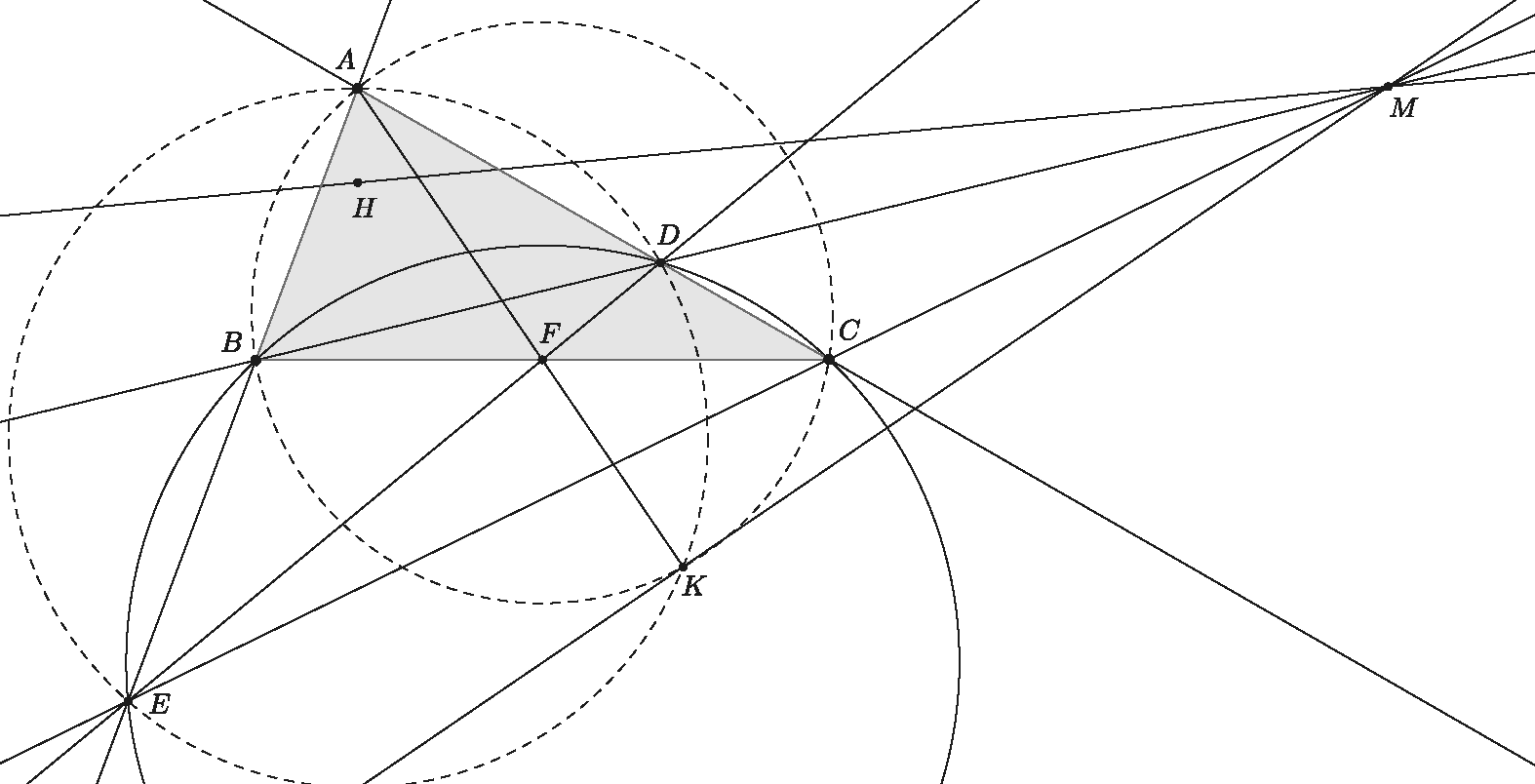
We use the result proved in A891: the center of the spiral similarity sending \(\displaystyle AB\) to \(\displaystyle CD\) is the intersection point of the Steiner line of quadrilateral \(\displaystyle ABDC\) and the perpendicular erected from the Miquel point \(\displaystyle M\) to the line through \(\displaystyle M\) and \(\displaystyle AB\cap CD\). (Here \(\displaystyle A,B,C,D\) denote arbitrary points.)
Now let us return to the problem. Observe that the center of the spiral similarity sending \(\displaystyle BE\) to \(\displaystyle CD\) is precisely \(\displaystyle M\) (by a standard similarity argument using inscribed angles). Let \(\displaystyle K\) be the Miquel point of quadrilateral \(\displaystyle BEDC\). Since \(\displaystyle BEDC\) is cyclic, we have \(\displaystyle K\in AF\). By A891, the point \(\displaystyle M\) is the intersection point of the line through \(\displaystyle K\) perpendicular to \(\displaystyle AK\) and the Steiner line. Moreover, A891 also implies that the pair of lines \(\displaystyle MH\) (the Steiner line) and \(\displaystyle MK\) is isogonal to the pair \(\displaystyle BM,CM\). Since in the angle region \(\displaystyle \angle BAC\) the lines \(\displaystyle BD\) and \(\displaystyle CE\) are antiparallel, the same is true for the lines \(\displaystyle MH\) and \(\displaystyle MK\). Since \(\displaystyle AK\perp MK\), the \(\displaystyle A\)-isogonal of \(\displaystyle AK\) is perpendicular to \(\displaystyle MH\), but this is exactly the \(\displaystyle A\)-symmedian.
Fourth solution.
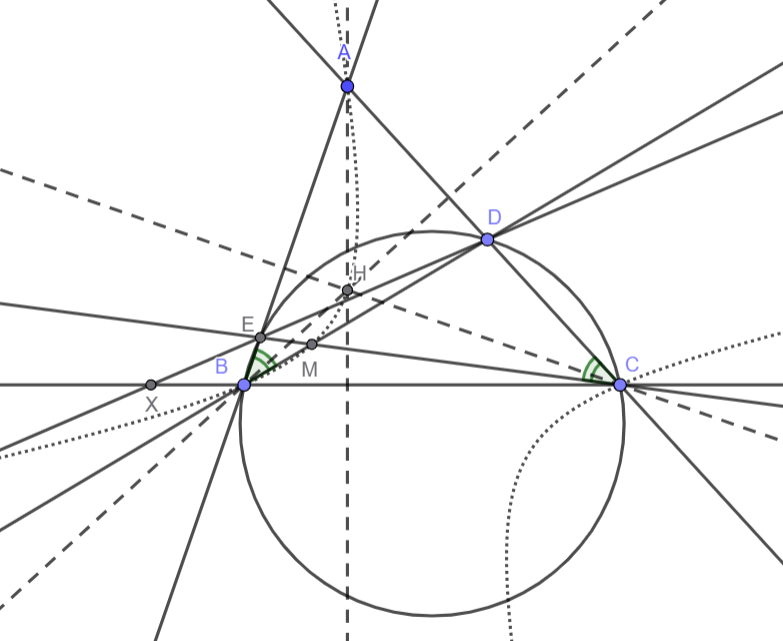
We prove the following more general statement: let \(\displaystyle D\) and \(\displaystyle E\) be points on the sidelines \(\displaystyle AC\) and \(\displaystyle AB\) of triangle \(\displaystyle ABC\) such that \(\displaystyle B,C,D,E\) are concyclic. Let the line \(\displaystyle DE\) intersect the line \(\displaystyle BC\) at \(\displaystyle X\). Let the lines \(\displaystyle BD\) and \(\displaystyle CE\) intersect at \(\displaystyle M\). We will show that \(\displaystyle HM\) is perpendicular to the reflection of line \(\displaystyle AX\) across the angle bisector through vertex \(\displaystyle A\), where \(\displaystyle H\) is the orthocenter of triangle \(\displaystyle ABC\).
Let \(\displaystyle Y\) denote the intersection point of the reflection of line \(\displaystyle AX\) across the angle bisector and the line \(\displaystyle HM\). We shall prove that the possible positions of \(\displaystyle Y\) lie on a conic. For this we use the well-known fact that two perspective pencils intersect in a conic. Thus it suffices to show that the correspondence between the line \(\displaystyle HM\) and the reflection of line \(\displaystyle AX\) preserves cross-ratios. Since reflection obviously preserves cross-ratios, it is enough to prove that the correspondence between the lines \(\displaystyle HM\) and \(\displaystyle AX\) is cross-ratio preserving.
First consider the correspondence between the two pencils in which the line \(\displaystyle BD\) corresponds to the line \(\displaystyle CE\). This correspondence is an isometry, since by the theorem on inscribed angles the directed angles \(\displaystyle \angle ABM\) and \(\displaystyle \angle MCA\) are equal. Hence the two pencils are perspective, and therefore their intersection point \(\displaystyle M\) lies on a conic. This conic contains the orthocenter of the triangle as well (obtained when \(\displaystyle D\) and \(\displaystyle E\) are the feet of the altitudes; these lie on the Thales circle over side \(\displaystyle BC\)), and it also contains the vertices of the triangle. The important point for us is vertex \(\displaystyle A\), obtained when the circle through \(\displaystyle B,C,D,E\) is the circumcircle of triangle \(\displaystyle ABC\).
Since the lines \(\displaystyle AX\), \(\displaystyle AM\), \(\displaystyle AB\), and \(\displaystyle AC\) form a harmonic bundle (because of the complete quadrilateral arising from \(\displaystyle BCDE\)), the correspondence sending \(\displaystyle AX\) to \(\displaystyle AM\) preserves cross-ratios. Thus, in order to prove our claim, it remains to show that the correspondence between \(\displaystyle AM\) and \(\displaystyle HM\) preserves cross-ratios, which is clear from the above, since \(\displaystyle M,A,H\) lie on a conic.
Since five points uniquely determine a conic, it suffices to find five points on the Thales circle over segment \(\displaystyle AH\). When \(\displaystyle D\) coincides with vertex \(\displaystyle C\), both \(\displaystyle X\) and \(\displaystyle M\) coincide with \(\displaystyle C\). In this case the reflection of \(\displaystyle AX\) is the line \(\displaystyle AB\), while \(\displaystyle HM\) is the altitude through \(\displaystyle B\), hence the required intersection point is the foot of the altitude from \(\displaystyle B\) on side \(\displaystyle AC\). By symmetry, the foot of the altitude on side \(\displaystyle AB\) also lies on the conic.
If both \(\displaystyle D\) and \(\displaystyle E\) coincide with vertex \(\displaystyle A\), then \(\displaystyle M\) also coincides with \(\displaystyle A\), and the intersection point of the two lines is \(\displaystyle A\). Clearly \(\displaystyle H\) also lies on the locus, when the line \(\displaystyle AX\) coincides with the reflection of the altitude through \(\displaystyle A\).
We still need one more point. Choose \(\displaystyle D\) and \(\displaystyle E\) such that both \(\displaystyle BD\) and \(\displaystyle CE\) are perpendicular to the angle bisector through \(\displaystyle A\) (in this case \(\displaystyle BECD\) is an isosceles trapezoid). Then \(\displaystyle M\) is the common point at infinity of the lines \(\displaystyle BD\) and \(\displaystyle CE\), so \(\displaystyle HM\) is parallel to them. Since the cyclic quadrilateral \(\displaystyle BEDC\) is symmetric with respect to the angle bisector, the point \(\displaystyle X\) lies on the angle bisector, hence the intersection point of the reflection of \(\displaystyle AX\) and \(\displaystyle HM\) is the foot of the perpendicular from \(\displaystyle H\) to the angle bisector. This completes the proof.
Statistics:
12 students sent a solution. 7 points: Aravin Peter, Bodor Mátyás, Bolla Donát Andor, Diaconescu Tashi, Forrai Boldizsár, Kis Ágoston, Li Mingdao, Sami El-Hajjar, Warren Maximilian Lin (9 students). 4 points: 1 student. 1 point: 1 student. 0 points: 1 student.
Problems in Mathematics of KöMaL, April 2026