

 Problem A. 936. (May 2026)
A. 936. Given an acute, scalene triangle \(\displaystyle ABC\) in the plane. Denote its symmedian point by \(\displaystyle K\) and the center of its Feuerbach circle by \(\displaystyle N\). Construct, using a compass and straightedge, distinct points \(\displaystyle X\), \(\displaystyle X^*\), \(\displaystyle Y\), \(\displaystyle Y^*\) such that
\(\displaystyle \bullet\) the lines \(\displaystyle XY\) and \(\displaystyle X^*Y^*\) intersect at \(\displaystyle K\);
\(\displaystyle \bullet\) the lines \(\displaystyle XX^*\) and \(\displaystyle YY^*\) intersect at \(\displaystyle N\);
\(\displaystyle \bullet\) the points \(\displaystyle X\) and \(\displaystyle X^*\), as well as \(\displaystyle Y\) and \(\displaystyle Y^*\), are isogonal conjugates with respect to the triangle.
Proposed by Áron Bán-Szabó, Palaiseau
(7 pont)
Deadline expired on June 10, 2026.
Solution. We shall prove that the first and second Napoleon points provide suitable choices, which we shall define shortly. To this end, we first present a proof of a relatively well-known lemma, and then establish the statement of the problem. Throughout the proof we shall work with directed angles.
Let us start with an arbitrary triangle \(\displaystyle ABC\). Let \(\displaystyle A_1\) denote the point on the perpendicular bisector of side \(\displaystyle BC\) such that \(\displaystyle \angle A_1BC = 30^{\circ}=-\angle A_1CB\). Furthermore, let \(\displaystyle A_2\) be the point on the perpendicular bisector of side \(\displaystyle BC\) such that \(\displaystyle \angle A_2CB = 30^{\circ}=-\angle A_2BC\). (Thus, \(\displaystyle A_1\) and \(\displaystyle A\) lie on opposite sides of the line \(\displaystyle BC\), whereas \(\displaystyle A_2\) and \(\displaystyle A\) lie on the same side.) Define the points \(\displaystyle B_1,B_2,C_1,C_2\) analogously.
Claim 1. The lines \(\displaystyle AA_1,BB_1,CC_1\) meet at a point \(\displaystyle N_1\), while the lines \(\displaystyle AA_2,BB_2,CC_2\) meet at a point \(\displaystyle N_2\).
Proof. We shall prove the statement in a more general form using projective geometry. More precisely, we shall show that if the points \(\displaystyle A_\delta,B_\delta,C_\delta\) lie on the perpendicular bisectors of the sides \(\displaystyle BC,CA,AB\), respectively, in such a way that \(\displaystyle \angle A_\delta BC=\angle B_\delta CA=\angle C_\delta AB=\delta\), then the lines \(\displaystyle AA_\delta,BB_\delta,CC_\delta\) are concurrent. To this end, let \(\displaystyle A_\delta\) move linearly along the perpendicular bisector of \(\displaystyle BC\). Then \(\displaystyle B_\delta\) also moves linearly, since it can be obtained as the intersection of the reflection of the line \(\displaystyle CA_\delta\) across the internal angle bisector at vertex \(\displaystyle C\) and the perpendicular bisector of side \(\displaystyle CA\) (it is important to note here that the triangle, and hence its angle bisectors and perpendicular bisectors, are fixed). We shall now use the following famous lemma:
If two points \(\displaystyle X\) and \(\displaystyle Y\) are given, and \(\displaystyle p\) is a projective map between the pencil of lines through \(\displaystyle X\) and the pencil of lines through \(\displaystyle Y\), then the points \(\displaystyle e\cap p(e)\) (where \(\displaystyle e\) ranges over the lines through \(\displaystyle X\)) lie on a curve of degree at most two passing through the points \(\displaystyle X\) and \(\displaystyle Y\).
Consequently, the intersection point of the lines \(\displaystyle AA_\delta\) and \(\displaystyle BB_\delta\) moves on a curve of degree at most two passing through \(\displaystyle A\) and \(\displaystyle B\). Similarly, the intersection point of the lines \(\displaystyle AA_\delta\) and \(\displaystyle CC_\delta\) moves on a curve of degree at most two passing through \(\displaystyle A\) and \(\displaystyle C\). If we show that these two curves coincide, we are done (since the vertices of the triangle also lie on this conic, the line \(\displaystyle AA_\delta\) will intersect it in exactly one point distinct from \(\displaystyle A\)). A conic is determined by five points, but since the point \(\displaystyle A\) lies on both curves, it suffices to find four values of \(\displaystyle \delta\) for which the lines \(\displaystyle AA_\delta,BB_\delta,CC_\delta\) are concurrent. Observe that if \(\displaystyle \delta=0^{\circ}\), then these three lines are precisely the three medians, which meet at the centroid. If \(\displaystyle \delta=90^{\circ}\), then the points \(\displaystyle A_\delta,B_\delta,C_\delta\) become the ideal points perpendicular to the corresponding sides, and hence the three lines are the three altitudes, which meet at the orthocenter. Finally, if \(\displaystyle A_\delta\) lies on the line \(\displaystyle AC\), then the three lines are concurrent at \(\displaystyle C\), while if \(\displaystyle A_\delta\) lies on the line \(\displaystyle AB\), then the three lines are concurrent at \(\displaystyle B\). This completes the proof.
The point \(\displaystyle N_1\) is called the first Napoleon point, while the point \(\displaystyle N_2\) is called the second Napoleon point.
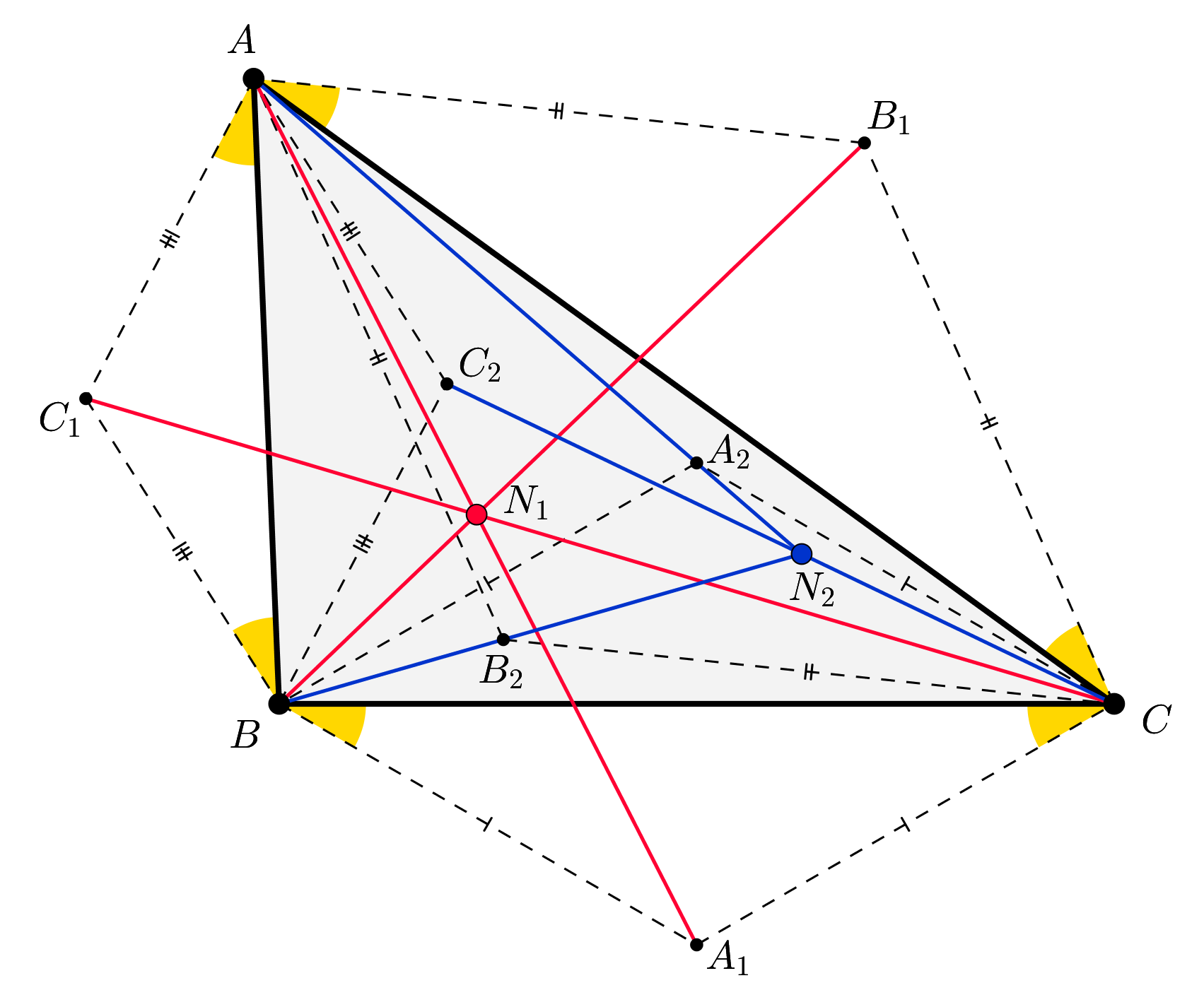
Claim 2. The line \(\displaystyle N_1N_2\) passes through the point \(\displaystyle K\).
Proof. Draw the tangents to the circumcircle of triangle \(\displaystyle ABC\) at its three vertices; these determine the triangle \(\displaystyle A'B'C'\). It is well known that \(\displaystyle K\) is the intersection point of the lines \(\displaystyle AA',BB',CC'\). Let \(\displaystyle M=N_1N_2\cap BC\), and let \(\displaystyle f\) be the perpendicular bisector of side \(\displaystyle AC\). Computing with cross-ratios, we obtain
\(\displaystyle (N_1,N_2;M,BB'\cap N_1N_2)=(BN_1,BN_2;BC,BB')\stackrel{f}{=}(B_1,B_2;BC\cap f,B')=(CB_1,CB_2;CB,CB').\)
Observe that \(\displaystyle \angle B'CB_1=\angle B'CA-30^{\circ}=\angle CBA-30^{\circ}=\angle CBC_2\), and similarly \(\displaystyle \angle C'BC_1=\angle BCB_2\). Furthermore, since \(\displaystyle \angle B_1CB_2=60^{\circ}=\angle C_2BC_1\),
\(\displaystyle (CB_1,CB_2;CB,CB')=(BC_1,BC_2;BC,BC'),\)
and similarly to the previous argument,
\(\displaystyle (BC_1,BC_2;BC,BC')=(N_1,N_2;M,CC'\cap N_1N_2).\)
Thus \(\displaystyle BB'\cap N_1N_2=CC'\cap N_1N_2=K\).
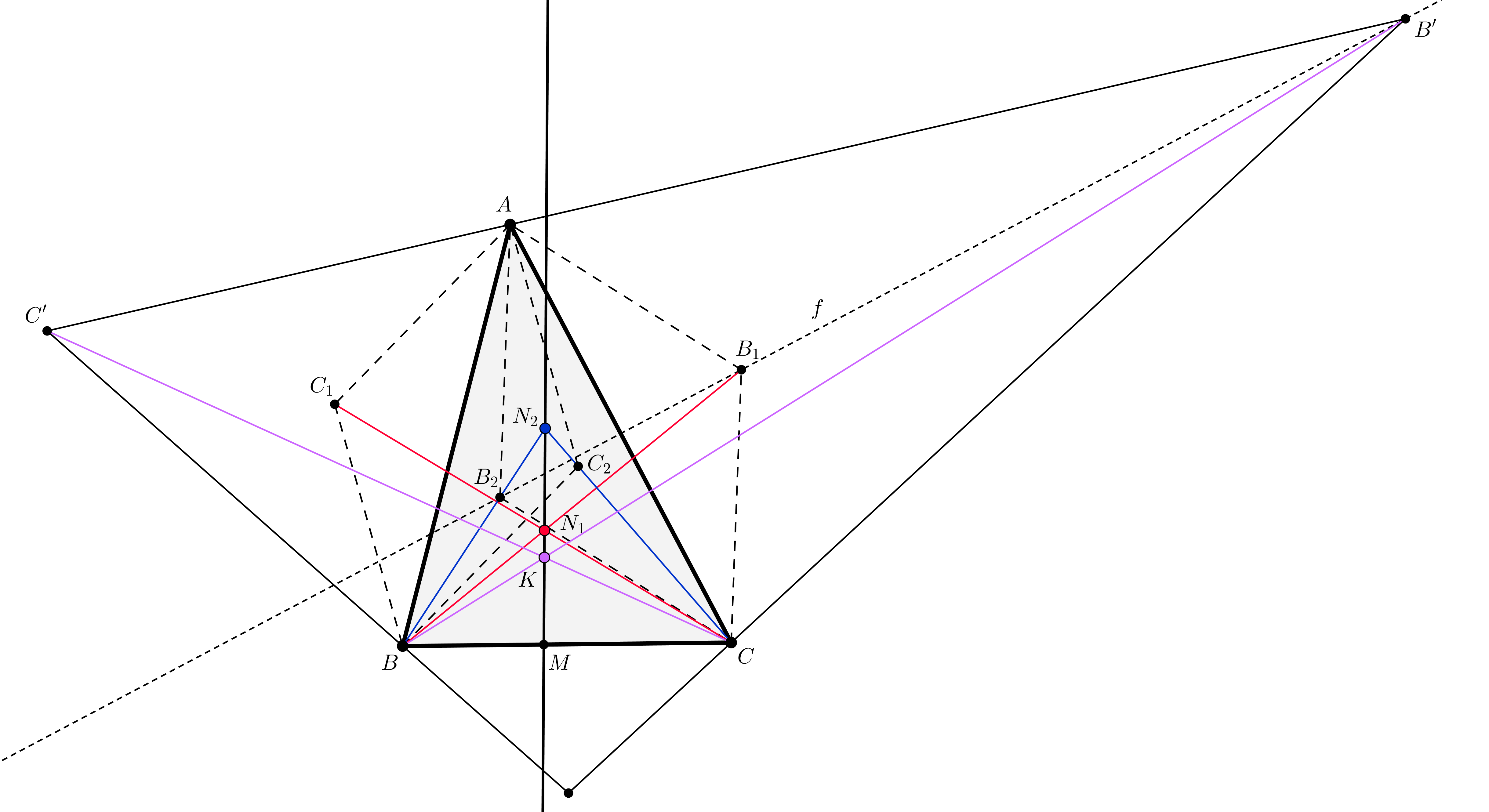
Claim 3. The line \(\displaystyle N_1^*N_2^*\) also passes through the point \(\displaystyle K\) (where \(\displaystyle X^*\) denotes the isogonal conjugate of the point \(\displaystyle X\)).
Proof. Observe that in the proof of Claim 1 we established that the points \(\displaystyle A,B,C,N_1,N_2\) and the centroid of the triangle lie on a curve of degree two (incidentally, this curve is called the Kiepert hyperbola). If we take the isogonal conjugate of this hyperbola, we obtain a line (since it passes through the vertices of the triangle), which passes through the isogonal conjugates of the points \(\displaystyle N_1,N_2\) and of the centroid. Since the centroid and \(\displaystyle K\) are isogonal conjugates, we have \(\displaystyle K\in N_1^*N_2^*\).
Claim 4. The lines \(\displaystyle A_1A_1^*,A_2A_2^*\) intersect at \(\displaystyle N\).
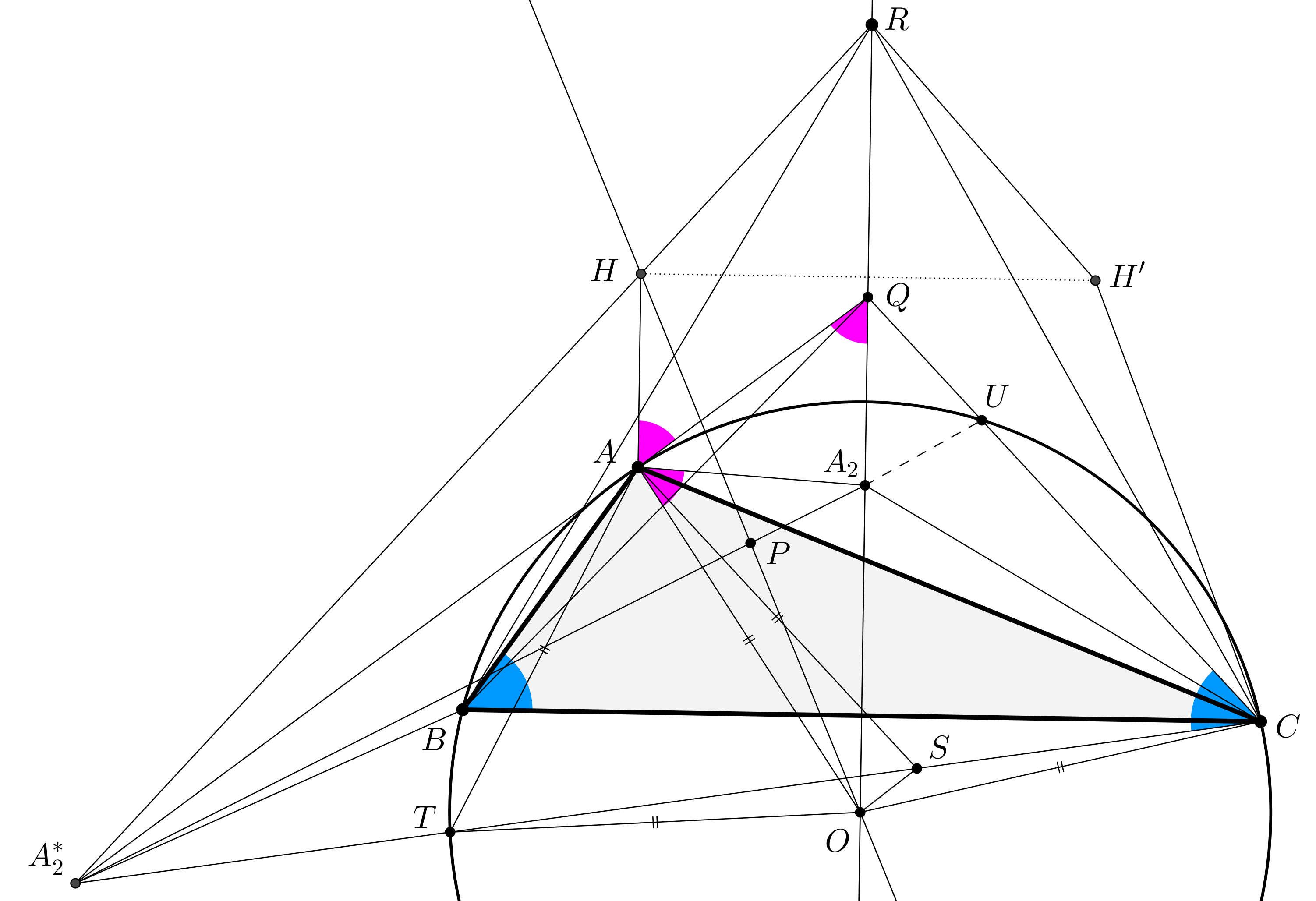
Proof. Let \(\displaystyle O\) be the circumcenter and \(\displaystyle H\) the orthocenter of the triangle. We shall prove that the line \(\displaystyle A_2A_2^*\) bisects the segment \(\displaystyle OH\). The same argument can then be carried out for the line \(\displaystyle A_1A_1^*\) as well, thereby proving the claim. Let \(\displaystyle P\) be the intersection of the line \(\displaystyle A_2A_2^*\) with the Euler line, and let \(\displaystyle Q\) be the intersection of the line \(\displaystyle AA_2^*\) with the perpendicular bisector of side \(\displaystyle BC\). Furthermore, let \(\displaystyle R\) be the point such that triangle \(\displaystyle BCR\) is equilateral and \(\displaystyle R\) lies on the same side of the line \(\displaystyle BC\) as \(\displaystyle A\) (thus \(\displaystyle A_2\) is the center of triangle \(\displaystyle BCR\)).
First, let us show that the points \(\displaystyle A_2^*,H,R\) are collinear. Observe that \(\displaystyle \angle RBH=\angle CBH-\angle CBR=90^{\circ}-\angle ACB-60^{\circ}=30^{\circ}-\angle ACB=\angle A_2CB-\angle ACB=\angle A_2CA=\angle BCA_2^*.\) Similarly, \(\displaystyle \angle RCH=\angle CBA_2^*\). Let \(\displaystyle H'\) be the reflection of \(\displaystyle H\) across the perpendicular bisector of side \(\displaystyle BC\). Then \(\displaystyle \angle H'BR=\angle RCH=\angle CBA_2^*,\) and similarly \(\displaystyle \angle H'CR=\angle RBH=\angle BCA_2^*,\) therefore \(\displaystyle H'\) and \(\displaystyle A_2^*\) are isogonal conjugates in triangle \(\displaystyle RBC\). Hence the lines \(\displaystyle RH'\) and \(\displaystyle RA_2^*\) are \(\displaystyle R\)-isogonal, that is, the points \(\displaystyle R,H,A_2^*\) are collinear.
Our goal is to apply Menelaus' theorem to triangle \(\displaystyle OHR\) with the line \(\displaystyle A_2^*A_2P\). This will allow us to determine the ratio \(\displaystyle HP/OP\), provided that we know the ratios \(\displaystyle HA_2^*/RA_2^*\) and \(\displaystyle RA_2/OA_2\).
Let us begin with the ratio \(\displaystyle HA_2^*/RA_2^*\). Since the lines \(\displaystyle HA\) and \(\displaystyle RQ\) are both perpendicular to \(\displaystyle BC\), and the points \(\displaystyle A_2^*,H,R\) are collinear, the triangles \(\displaystyle A_2^*HA\) and \(\displaystyle A_2^*RQ\) are similar, hence \(\displaystyle HA_2^*/RA_2^*=AA_2^*/QA_2^*.\) Let the line \(\displaystyle A_2^*C\) intersect the line through \(\displaystyle A\) parallel to \(\displaystyle QC\) at \(\displaystyle S\), and let it intersect the circumcircle of triangle \(\displaystyle ABC\) again at \(\displaystyle T\). We shall prove that \(\displaystyle AS=AO\). Observe that \(\displaystyle \angle AOT=2\angle ACT=2\angle ACA_2^*=2\angle A_2CB=60^{\circ},\) therefore triangle \(\displaystyle ATO\) is equilateral. To proceed, observe that the points \(\displaystyle A_2\) and \(\displaystyle Q\) are inverses with respect to the circumcircle \(\displaystyle (ABC)\). This follows from \(\displaystyle \angle AQO=\angle QAH=\angle OAA_2,\) since the pairs of lines \(\displaystyle AO-AH\) and \(\displaystyle AA_2-AA_2^*\) are \(\displaystyle A\)-isogonal. Now let the line \(\displaystyle QC\) intersect the circle \(\displaystyle (ABC)\) again at \(\displaystyle U\). Then the points \(\displaystyle B,A_2,U\) are collinear. For instance, this can be justified by projecting the harmonic quadruple \(\displaystyle (A_2,Q;O,\infty)\)—where \(\displaystyle \infty\) is the ideal point of the perpendicular bisector of \(\displaystyle BC\)—from \(\displaystyle U\) onto the circle \(\displaystyle (ABC)\). We then obtain an isosceles trapezoid, and hence the line \(\displaystyle UA_2\) must intersect the circle \(\displaystyle (ABC)\) at \(\displaystyle B\). From inscribed angles we obtain \(\displaystyle \angle STA=\angle CSA=\angle CBA=\angle CBA_2+\angle A_2BA=30^{\circ}+\angle UBA=30^{\circ}+\angle UCA=\angle A_2CB+\angle UCA=\angle ACS+\angle UCA=\angle QCS=\angle AST.\) Therefore \(\displaystyle AS=AT=AO\).
We are now ready to compute the required ratios. Since the triangles \(\displaystyle A_2^*OA\) and \(\displaystyle A_2^*CQ\) are similar, \(\displaystyle AA_2^*/QA_2^*=AS/QC.\) We already know that \(\displaystyle AS=AO=CO\), and since \(\displaystyle Q\) and \(\displaystyle A_2\) are inverse points with respect to the circumcircle, \(\displaystyle QC=\dfrac{A_2C\cdot CO}{A_2O}.\) Moreover, \(\displaystyle RA_2=CA_2\), hence
\(\displaystyle \dfrac{HP}{OP}=\dfrac{HA_2^*}{RA_2^*}\cdot \dfrac{RA_2}{OA_2}=\dfrac{CO}{\frac{A_2C\cdot CO}{A_2O}}\cdot \dfrac{CA_2}{OA_2}=1.\)
Therefore indeed \(\displaystyle P=N\). Similarly, one can show that the lines \(\displaystyle A_1A_1^*,B_1B_1^*,B_2B_2^*,C_1C_1^*,C_2C_2^*\) also pass through \(\displaystyle N\).
Claim 5. The lines \(\displaystyle N_1N_1^*,N_2N_2^*\) intersect at \(\displaystyle N\).
Proof. Consider the triangles \(\displaystyle BC_1C_1^*\) and \(\displaystyle CB_1B_1^*\). Observe that \(\displaystyle BC_1\cap CB_1=A_1^*\), \(\displaystyle C_1C_1^*\cap B_1B_1^*=N\), and \(\displaystyle BC_1^*\cap CB_1^*=A_1\), and by the previous claim these three points are collinear. In light of this, the triangles \(\displaystyle BC_1C_1^*\) and \(\displaystyle CB_1B_1^*\) are perspective from a line, hence by Desargues' theorem also perspective from a point. Therefore the lines \(\displaystyle BC,B_1C_1,B_1^*C_1^*\) are concurrent, so the triangles \(\displaystyle BB_1B_1^*\) and \(\displaystyle CC_1C_1^*\) are perspective from a point, hence also from a line. Thus the points \(\displaystyle BB_1\cap CC_1=N_1\), \(\displaystyle B_1B_1^*\cap C_1C_1^*=N\), \(\displaystyle B_1^*B\cap C_1^*C=N_1^*\) are collinear. Similarly, one can prove that the line \(\displaystyle N_2N_2^*\) also passes through \(\displaystyle N\).
This proves the problem; \(\displaystyle X=N_1\) and \(\displaystyle Y=N_2\) are suitable choices.
Statistics:
7 students sent a solution. 7 points: Bodor Mátyás, Forrai Boldizsár (2 students). 5 points: 1 student. 4 points: 1 student. 3 points: 2 students. 0 points: 1 student.
Problems in Mathematics of KöMaL, May 2026