

 Problem A. 942. (October 2026)
A. 942. Let \(\displaystyle ABCD\) be a cyclic quadrilateral without right angles. Let \(\displaystyle E\) denote the midpoint of diagonal \(\displaystyle AC\), and let \(\displaystyle F\) denote the midpoint of diagonal \(\displaystyle BD\). Suppose that the circles \(\displaystyle AEF\), \(\displaystyle BEF\), \(\displaystyle CEF\), \(\displaystyle DEF\) do not degenerate into lines, and they intersect the circumcircle of \(\displaystyle ABCD\) for the second time at \(\displaystyle A'\), \(\displaystyle B'\), \(\displaystyle C'\), \(\displaystyle D'\), respectively.
Let \(\displaystyle E'\) be the midpoint of segment \(\displaystyle A'C'\), and let \(\displaystyle F'\) be the midpoint of segment \(\displaystyle B'D'\). Prove that points \(\displaystyle E\), \(\displaystyle F\), \(\displaystyle E'\), \(\displaystyle F'\) lie on the same circle.
Proposed by Ákos Somogyi, London
(7 pont)
Deadline expired on November 10, 2026.
Solution: Let \(\displaystyle AB\cap CD=P\), \(\displaystyle BC\cap AD=Q\) and \(\displaystyle AC\cap BD=R\). Denote the center of the circle \(\displaystyle (ABCD)\) by \(\displaystyle O\). We will prove that the points \(\displaystyle E,F,E',F'\) lie on the circle with diameter \(\displaystyle OR\). For the first two points, the claim follows easily: since \(\displaystyle E\) and \(\displaystyle F\) are both midpoints of chords passing through \(\displaystyle R\), the segment \(\displaystyle OR\) is seen under a right angle from both points. We will prove that \(\displaystyle E',F'\) lie on this circle in a similar way; it suffices to show that the chords \(\displaystyle A'C',B'D'\) also pass through \(\displaystyle R\). By symmetry, it is enough to prove this for the chord \(\displaystyle A'C'\). We will present two different ways to complete the proof.
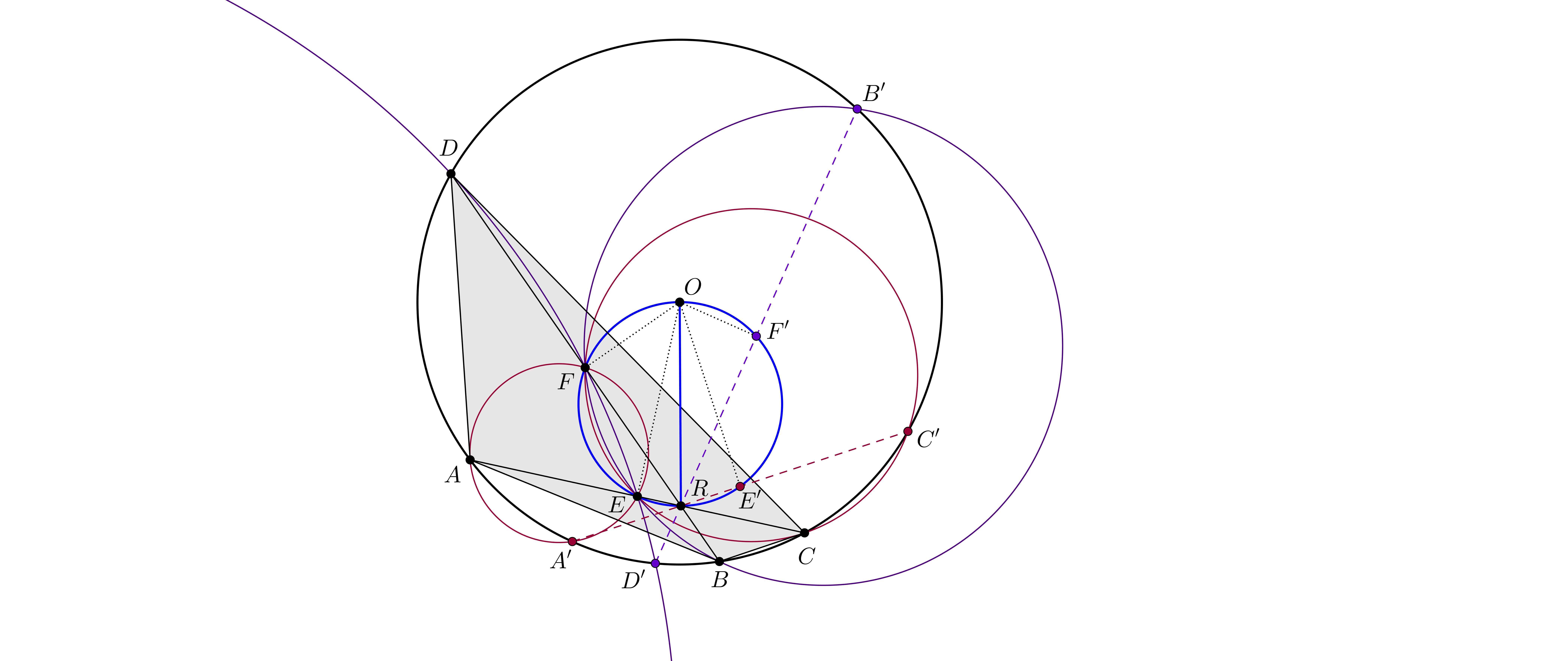
1. First approach using inversion and poles and polars: Let \(\displaystyle M\) be the midpoint of the segment \(\displaystyle PQ\). We will use Brocard's theorem, which states that the vertices of the triangle \(\displaystyle PQR\) are the poles of the opposite sidelines with respect to the circle \(\displaystyle (ABCD)\). We will also use the fact that the points \(\displaystyle E,F,M\) are collinear; the line containing them is called the Newton-Gauss line. (It is important to consider separately the case when \(\displaystyle ABCD\) is a cyclic trapezoid, since in this case either \(\displaystyle P\) or \(\displaystyle Q\) is a point at infinity. Fortunately, this case is quite easy, as the points \(\displaystyle A',B',C',D'\) are either \(\displaystyle B,A,D,C\) or \(\displaystyle D,C,B,A\), respectively.)
Consider inversion with respect to the circle with diameter \(\displaystyle PQ\). A direct consequence of Brocard's theorem is that the circles with diameters \(\displaystyle PQ\) and \(\displaystyle OR\) are orthogonal (since \(\displaystyle O\) is the orthocenter of triangle \(\displaystyle PQR\)), so \(\displaystyle E\) and \(\displaystyle F\) are inverses of each other under this inversion (since the line \(\displaystyle EF\) is mapped to itself, as it passes through the center of inversion, and the circle with diameter \(\displaystyle OR\) is also mapped to itself because of the orthogonality). Furthermore, we know that the circle with diameter \(\displaystyle PQ\) is orthogonal to the circle \(\displaystyle (ABCD)\), since \(\displaystyle O\) is the orthocenter of triangle \(\displaystyle PQR\), and thus the lines \(\displaystyle OP,OQ\) are altitudes of this triangle, so they pass through the inverses of \(\displaystyle P,Q\), respectively, with respect to the circle \(\displaystyle (ABCD)\) (which, by Brocard's theorem, are the feet of these altitudes). This means that under the original inversion with respect to the circle with diameter \(\displaystyle PQ\), the circles \(\displaystyle (ABCD),(AEF)\) are also mapped to themselves, which can only happen if \(\displaystyle A\) is mapped to \(\displaystyle A'\), and hence \(\displaystyle M\in AA'\). Similarly, we obtain \(\displaystyle M\in CC'\).
Finally, let \(\displaystyle R_1=AC\cap A'C'\) and denote the polar of \(\displaystyle R_1\) by \(\displaystyle r_1\). Our goal is to prove that \(\displaystyle R=R_1\). Since \(\displaystyle R\in AC\), the pole of the line \(\displaystyle AC\) - let us call it \(\displaystyle U\) - lies on the polar of \(\displaystyle R\), which is the line \(\displaystyle PQ\) (La Hire's theorem). Moreover, since \(\displaystyle R_1\in AC\), we have \(\displaystyle U\in r_1\), and now applying Brocard's theorem to the cyclic quadrilateral \(\displaystyle AA'CC'\), we obtain \(\displaystyle M\in r_1\). Thus, both \(\displaystyle r_1\) and \(\displaystyle PQ\) pass through \(\displaystyle U\) and \(\displaystyle M\), so they coincide, and hence their poles coincide as well: \(\displaystyle R_1=R\).
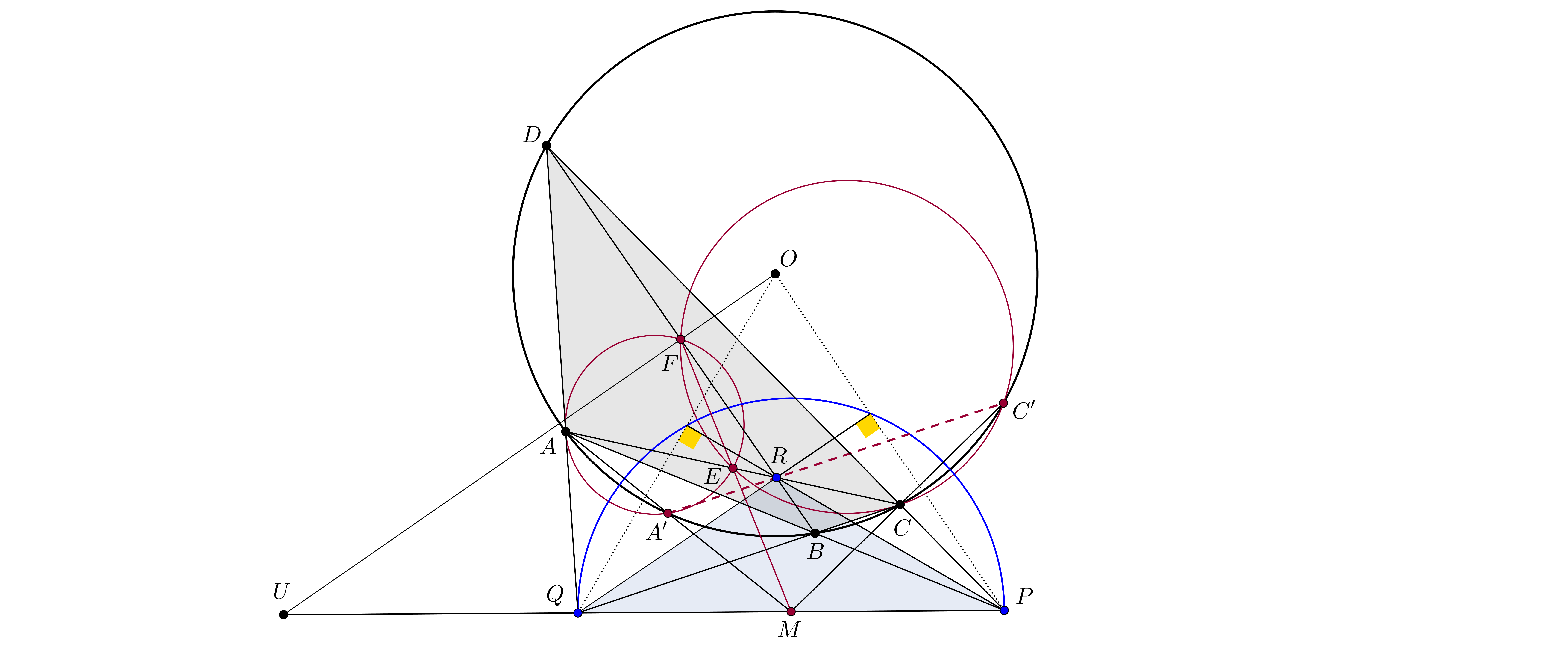
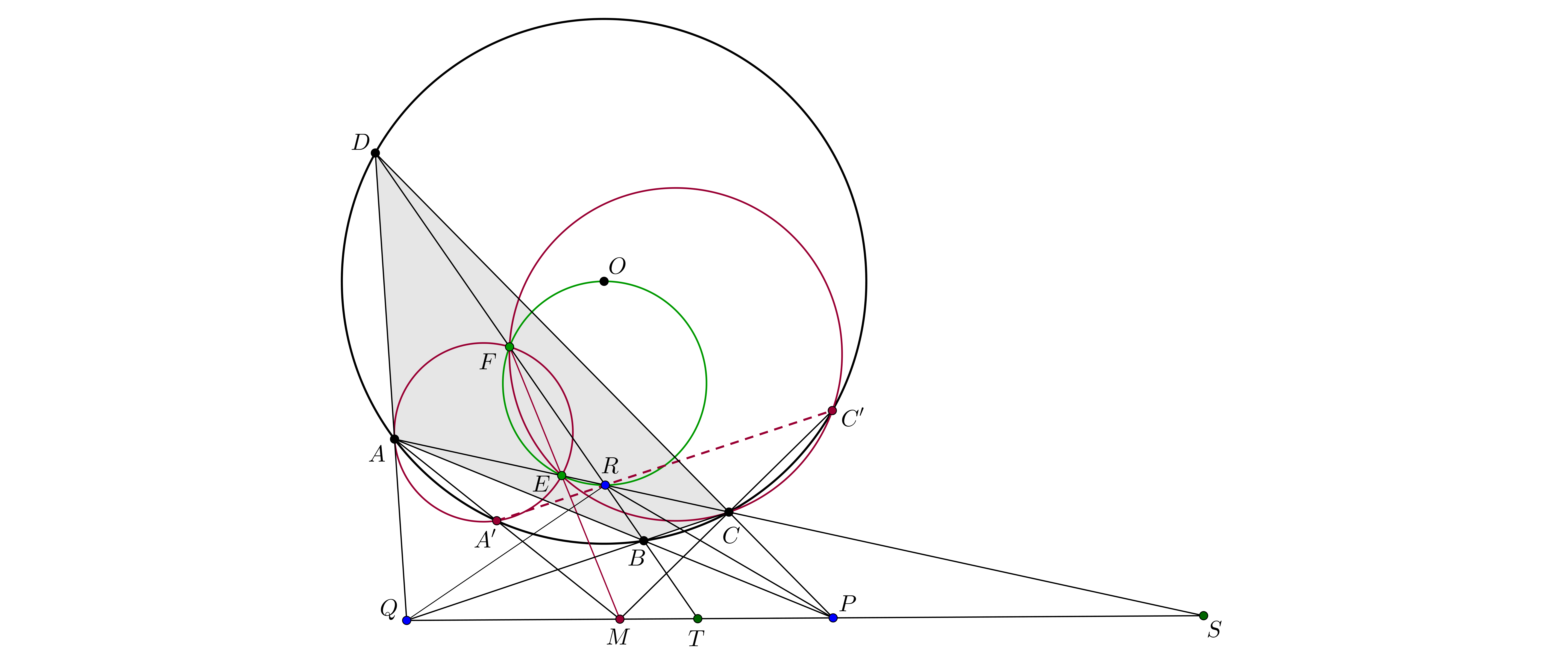
2. Second approach using radical axes and projective geometry: We begin by proving here as well that the lines \(\displaystyle AA',CC',EF\) intersect at a point \(\displaystyle M\in PQ\). To do this, we first show that the radical axis of the circles \(\displaystyle (OREF)\) and \(\displaystyle (ABCD)\) is precisely the line \(\displaystyle PQ\). Let \(\displaystyle S=AC\cap PQ\) and \(\displaystyle T=BD\cap PQ\). It is known that in this configuration (in fact, not only for cyclic quadrilaterals) \(\displaystyle (P,Q;S,T)=(A,C;S,R)=(B,D;R,T)=-1\). It follows that \(\displaystyle SA\cdot RC=SC\cdot AR\), so, working with directed segments,
$$\begin{align*} \textrm{Pow}_{(ABCD)}(S) &=SA\cdot SC =SA\cdot(SR+RC) =SA\cdot SR+SA\cdot RC=\\ &=SA\cdot SR+\frac{SC\cdot AR+SA\cdot RC}{2} =SA\cdot SR+\frac{(SR+RC)\cdot AR+(SR-AR)\cdot RC}{2}=\\ &=SA\cdot SR+\frac{SR(AR+RC)}{2} =SA\cdot SR+SR\cdot AE =(SA+AE)\cdot SR=SE\cdot SR\\ &=\textrm{Pow}_{(OREF)}(S), \end{align*}$$so \(\displaystyle S\) lies on the radical axis of the circles \(\displaystyle (OREF),(ABCD)\). Similarly, \(\displaystyle T\) also lies on it, so the radical axis is indeed the line \(\displaystyle PQ\). If we consider the pairwise radical axes of the circles \(\displaystyle (ABCD),(AA'EF),(CC'EF),(OREF)\), we obtain precisely the lines \(\displaystyle PQ,AA',EF,CC'\), which are therefore concurrent at the common radical center \(\displaystyle M\) of the circles. (The cases where \(\displaystyle S\) or \(\displaystyle T\) is a point at infinity must be considered separately, since in these cases we cannot work with distances; we leave these cases to the reader.)
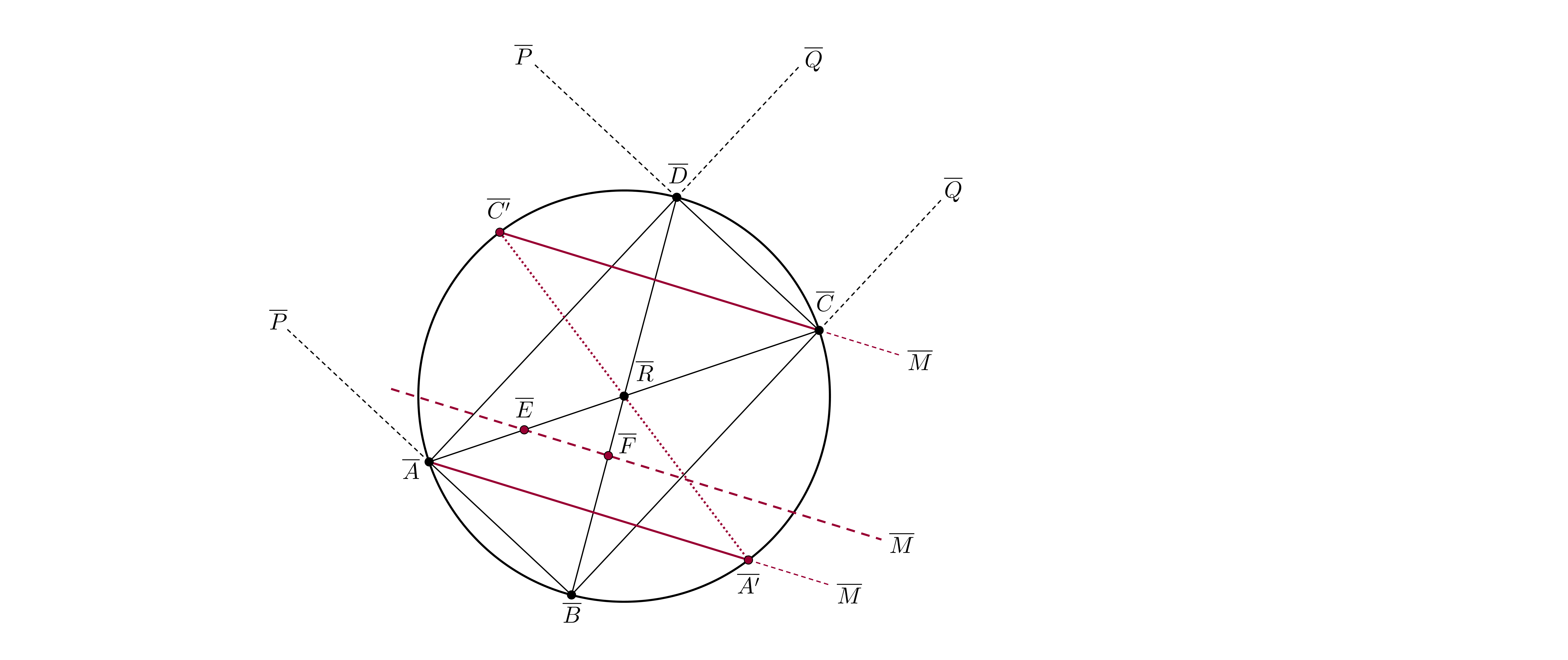
Now we use the known fact that, given a circle \(\displaystyle \omega\) and a point \(\displaystyle X\) inside it, there exists a projective transformation of the plane that maps \(\displaystyle \omega\) to a circle \(\displaystyle \omega'\) and \(\displaystyle X\) to its center. We apply this to the circle \(\displaystyle (ABCD)\) and the point \(\displaystyle R\) inside it. Denote the image of each point \(\displaystyle Y\) under the transformation by \(\displaystyle \overline{Y}\). Clearly, \(\displaystyle \overline{ABCD}\) is a rectangle, and it remains to show that \(\displaystyle \overline{A'C'}\) is a diameter of the circle \(\displaystyle \overline{(ABCD)}\). Notice that \(\displaystyle \overline{P}\) and \(\displaystyle \overline{Q}\) are both points at infinity, so the line \(\displaystyle \overline{PQ}\) is the line at infinity, and hence \(\displaystyle \overline{M}\) is also a point at infinity. However, we know that \(\displaystyle AA',CC'\cap M\), so \(\displaystyle \overline{AA'}\cap \overline{CC'}=\overline{M}\). Thus, the lines \(\displaystyle \overline{AA'},\overline{CC'}\) are parallel, and since \(\displaystyle \overline{AC}\) is a diameter of the circle \(\displaystyle \overline{(ABCD)}\), so is \(\displaystyle \overline{A'C'}\), which indeed gives \(\displaystyle \overline{R}\in \overline{A'C'}\Leftrightarrow R\in A'C'\).
Statistics:
Problem A. 942. is not processed yet.
Problems in Mathematics of KöMaL, October 2026