

 Problem K. 884. (January 2026)
K. 884. A number is called a zigzag number if, when reading its digits from left to right, the second digit is smaller than the first, the third digit is larger than the second, the fourth digit is smaller than the third, and so on. Create all the zigzag numbers from digits \(\displaystyle 1\), \(\displaystyle 2\), \(\displaystyle 3\), \(\displaystyle 4\), \(\displaystyle 5\), i.e., all five-digit numbers \(\displaystyle \overline{abcde}\) with all different digits satisfying \(\displaystyle a>b\), \(\displaystyle b<c\), \(\displaystyle c>d\) and \(\displaystyle d<e\). How many such five-digit zigzag numbers are there?
(5 pont)
Deadline expired on February 10, 2026.
Sorry, the solution is available only in Hungarian. Google translation
1. megoldás. Mivel \(\displaystyle c > b\) és \(\displaystyle c > d\), így \(\displaystyle c\) \(\displaystyle 3\), \(\displaystyle 4\) vagy \(\displaystyle 5\) lehet csak, valamint az \(\displaystyle 1\) csak \(\displaystyle b\) vagy \(\displaystyle d\) lehet és sem \(\displaystyle b\), sem \(\displaystyle d\) nem lehet \(\displaystyle 4\) vagy \(\displaystyle 5\).
Ha \(\displaystyle c = 3\), akkor \(\displaystyle b\) és \(\displaystyle d\) csak \(\displaystyle 1\) és \(\displaystyle 2\) lehet valamilyen sorrendben, valamint \(\displaystyle a\) és \(\displaystyle e\) pedig \(\displaystyle 4\) és \(\displaystyle 5\) valamilyen sorrendben, így ez \(\displaystyle 2\cdot2=4\) lehetőség. (\(\displaystyle 41325\), \(\displaystyle 51324\), \(\displaystyle 42315\), \(\displaystyle 52314\).)
Ha \(\displaystyle c = 4\), akkor \(\displaystyle b\) és \(\displaystyle d\) közül az egyik \(\displaystyle 1\), a másik csak \(\displaystyle 2\) vagy \(\displaystyle 3\) lehet valamilyen sorrendben. Ezek a lehetőségek vannak: \(\displaystyle 31425\), \(\displaystyle 51423\), \(\displaystyle 32415\), \(\displaystyle 52413\), \(\displaystyle 21435\), \(\displaystyle 53412\), ami \(\displaystyle 6\) lehetőség.
Ha \(\displaystyle c = 5\), akkor \(\displaystyle b\) és \(\displaystyle d\) közül az egyik \(\displaystyle 1\), a másik csak \(\displaystyle 2\) vagy \(\displaystyle 3\) lehet valamilyen sorrendben. Ezek a lehetőségek vannak: \(\displaystyle 31524\), \(\displaystyle 41523\), \(\displaystyle 32514\), \(\displaystyle 42513\), \(\displaystyle 21534\), \(\displaystyle 43512\), ami \(\displaystyle 6\) lehetőség.
Összesen \(\displaystyle 16\) ilyen ötjegyű szám van.
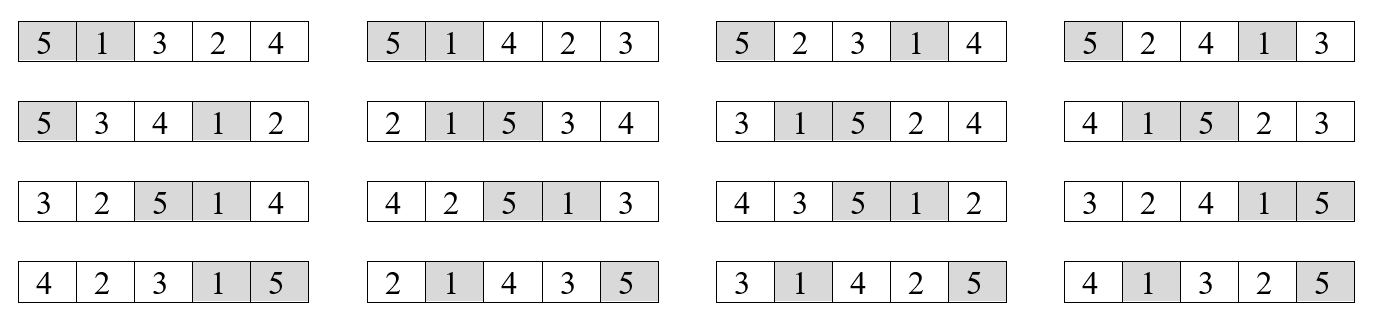
2. megoldás. Az \(\displaystyle 5\) lehet \(\displaystyle a\) vagy \(\displaystyle c\) vagy \(\displaystyle e\) helyén. Az \(\displaystyle 1\) pedig csakis \(\displaystyle b\) vagy \(\displaystyle d\) helyén. Vegyül sorra szisztematikusan!
Statistics:
130 students sent a solution. 5 points: 90 students. 4 points: 8 students. 3 points: 16 students. 2 points: 3 students. 1 point: 1 student. 0 point: 3 students. Unfair, not evaluated: 8 solutionss. Not shown because of missing birth date or parental permission: 1 solutions.
Problems in Mathematics of KöMaL, January 2026