

 Problem P. 5604. (November 2024)
P. 5604. The electromotive force (emf) of a flat-pack lantern battery is \(\displaystyle U_0=4.5~\mathrm{V}\), its internal resistance is \(\displaystyle R_\mathrm{i}=1.5~\Omega\). We have two alike incandescent bulbs, whose \(\displaystyle I(U)\) characteristics is shown in the figure.
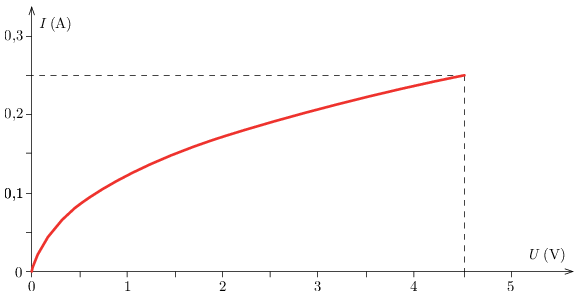
a) How does the terminal voltage of the battery depend on the current? Graph the \(\displaystyle I(U)\) characteristics of the battery.
b) A bulb is connected to the battery. Using the \(\displaystyle I(U)\) graph determine the voltage across the bulb and the current flowing through the bulb (the so-called operating point).
c) The two bulbs are connected
i) in parallel
ii) in series
and then they are connected to the battery. Plot the \(\displaystyle I(U)\) characteristics of the two bulbs (together) when they are connected in series and in parallel, and then determine the new operating point in both cases. Then determine in both cases the voltage across one bulb, and the current flowing through one bulb.
(5 pont)
Deadline expired on December 16, 2024.
Sorry, the solution is available only in Hungarian. Google translation
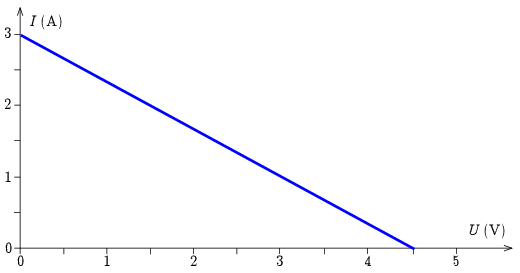
Megoldás. a) A belső ellenálláson \(\displaystyle U_\mathrm{b}=R_\mathrm{b}I\) feszültség esik, így a kapocsfeszültség \(\displaystyle U=U_0-R_\mathrm{b}I\). Ez alapján a telep árama a kapocsfeszültség függvényében
\(\displaystyle I=\frac{U_0-U}{R_\mathrm{b}},\)
amely grafikusan az 1. ábrán látható. (Figyelem! A grafikon skálája más.)
1. ábra
Megjegyzés. Az \(\displaystyle I_\mathrm{r}=\tfrac{U_0}{R_\mathrm{b}}\) áramot rövidzárási áramnak nevezzük, ilyenkor a kapocsfeszültség nulla. Az \(\displaystyle U_0\) feszültséget szokás üresjárási feszültségnek is nevezni, ilyenkor a telepen át folyó áram nulla.
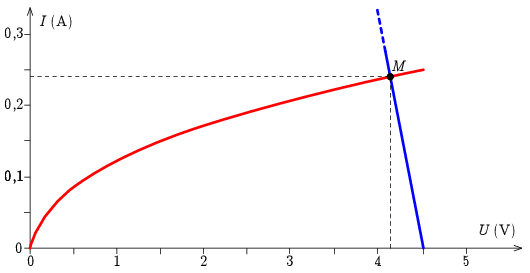
b) Rajzoljuk a telep és az izzó karakterisztikáját közös grafikonba!
2. ábra
A munkapont (\(\displaystyle M\)) a két görbe metszéspontja. A grafikonról leolvasva:
\(\displaystyle U_1\approx 4{,}14\,\mathrm{V}\quad\textrm{és}\quad I_1\approx 0{,}240\,\mathrm{A}.\)
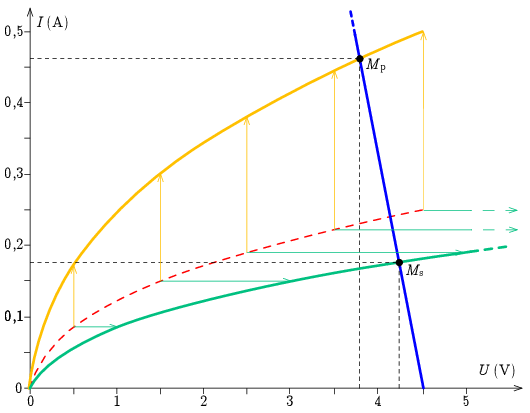
c) Ha a két izzót párhuzamosan kapcsoljuk, akkor feszültségük megegyezik, áramaik összeadódnak. Az eredő kapcsolás karakterisztikáját az eredeti izzókarakterisztika kétszeres függőleges nyújtásával kapjuk meg (a grafikonon sárga görbe). A soros kapcsolás esetében a két izzó árama egyezik meg, és feszültségeik adódnak össze, így ekkor a karakterisztikát vízszintesen kell kétszeresére megnyújtani (a grafikonon zöld görbe). Ezután a munkapontokat az előzőhöz hasonlóan szerkeszthetjük meg.
3. ábra
A grafikonról leolvasva párhuzamos esetben a munkapont (\(\displaystyle M_\mathrm{p}\)) \(\displaystyle U_\mathrm{p}\approx 3{,}80\,\mathrm{V}\) és \(\displaystyle I_\mathrm{p}\approx 0{,}462\,\mathrm{A}\), soros esetben pedig (\(\displaystyle M_\mathrm{s}\)) \(\displaystyle U_\mathrm{s}\approx 4{,}24\,\mathrm{V}\) és \(\displaystyle I_\mathrm{s}\approx 0{,}176\,\mathrm{A}\). Ebből már könnyen meghatározhatjuk mindkét esetben egy-egy izzó feszültségét és áramát:
$$\begin{gather*} U_\mathrm{p1}=U_\mathrm{p}\approx 3{,}80\,\mathrm{V}\quad\textrm{és}\quad I_\mathrm{p1}=\frac{I_\mathrm{p}}{2}\approx 0{,}231\,\mathrm{A},\\ U_\mathrm{s1}=\frac{U_\mathrm{s}}{2}\approx 2{,}12\,\mathrm{V}\quad\textrm{és}\quad I_\mathrm{s1}=I_\mathrm{s}\approx 0{,}176\,\mathrm{A}. \end{gather*}$$Statistics:
12 students sent a solution. 5 points: Csipkó Hanga Zoé , Sütő Áron, Ujpál Bálint. 4 points: Blaskovics Ádám, Fekete Lúcia, Masa Barnabás, Simon János Dániel. 3 points: 3 students. 0 point: 1 student.
Problems in Physics of KöMaL, November 2024