

 Problem P. 5661. (September 2025)
P. 5661. A trolley with mass \(\displaystyle m_1=4~\mathrm{kg}\) rolls without friction on the horizontal ground at a speed of \(\displaystyle v_1=2~\mathrm{m}/\mathrm{s}\). A brick of mass \(\displaystyle m_2=1~\mathrm{kg}\) is held by a grabber above the subsequent path of the trolley, just at the height of the trolley (as shown in the figure). When the trolley gets underneath the brick, the grabber releases the brick, which is then placed on the trolley. (Its vertical displacement, and hence the speed at which the brick reaches the trolley, is negligible.) There is friction between the trolley and the brick, the coefficient of friction is \(\displaystyle \mu=0.2\). The trolley is long enough to prevent the brick from sliding off of it.
a) What is the common speed at which the brick and the trolley move when the brick is no longer sliding on the trolley?
b) How much distance does the brick cover and for how long does the brick slide on the trolley before this common speed is reached?
c) What distance relative to the ground is covered during this by the brick and by the trolley?
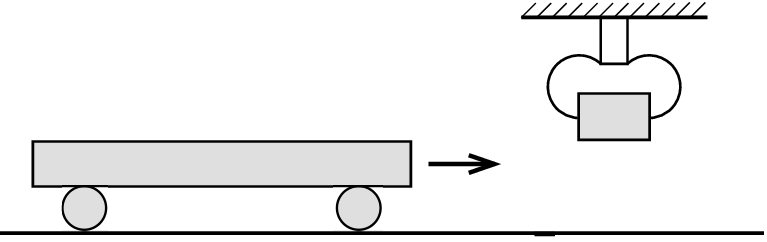
(4 pont)
Deadline expired on October 15, 2025.
Sorry, the solution is available only in Hungarian. Google translation
Megoldás. A kocsira került tégla a súrlódás hatására egyenletesen gyorsul, míg a kocsi egyenletesen lassul. Ez a folyamat addig tart, ameddig a tégla és a kocsi sebessége azonossá nem válik, ettől az időponttól a két test állandó sebességgel együtt halad tovább. A kocsi \(\displaystyle a_1\) és a tégla \(\displaystyle a_2\) gyorsulását (a kiskocsi mozgásának irányát véve pozitívnak) az
$$\begin{align*} m_1a_1&=-\mu m_2g,\\ m_2a_2&=\mu m_2g \end{align*}$$egyenletek adják meg. Ezek segítségével a pillanatnyi sebességek és a talajhoz viszonyítva megtett utak (így a relatív elmozdulás is) az egyenletesen változó mozgás egyenletei alapján megadhatók, de a kérdésekben szereplő mennyiségek meghatározásához nem kell minden részletet kidolgoznunk.
a) A kialakuló \(\displaystyle v_\mathrm{k}\) közös sebességet az impulzus megmaradás törvénye alapján számoljuk ki:
\(\displaystyle v_1m_1=v_\mathrm{k}\left(m_1+m_2\right),\qquad\textrm{azaz}\qquad v_\mathrm{k}=v_1\frac{m_1}{m_1+m_2}=1{,}6\,\mathrm{m/s}.\)
b) A csúszás addig tart, amíg a tégla fel nem gyorsul erre a sebességre. Az ehhez szükséges idő
\(\displaystyle t=\frac{v_\mathrm{k}}{a_2}=\frac{v_1}{\mu g}\frac{m_1}{m_1+m_2}=0{,}82\,\mathrm{s}.\)
Ez alatt a téglának a kiskocsihoz viszonyított \(\displaystyle u\) sebessége \(\displaystyle -v_1\)-ről egyenletesen nullára változik, a relatív sebesség átlaga tehát
\(\displaystyle \overline{u}=-\frac{v_1}{2},\)
amivel az adott idő alatt
\(\displaystyle s=-\frac{v_1^2}{2\mu g}\frac{m_1}{m_1+m_2}=-0{,}82\,\mathrm{m}\)
értékkel mozdul el a platóhoz képest. (Az előjel arra utal, hogy ez az elmozdulás a kocsi mozgásával ellentétes irányú.)
c) A kiskocsi sebessége \(\displaystyle v_1\)-ről egyenletesen \(\displaystyle v_\mathrm{k}\)-ra változik, így a megtett útja
\(\displaystyle s_1=\frac{v_1+v_\mathrm{k}}{2}t=\frac{v_1^2}{2\mu g}\frac{\left(2m_1+m_2\right)m_1}{\left(m_1+m_2\right)^2}=1{,}47\,\mathrm{m}.\)
A tégla talajhoz viszonyított sebessége nulláról \(\displaystyle v_\mathrm{k}\)-ra nő, ebből a talajhoz viszonyított elmozdulása
\(\displaystyle s_2=\frac{v_\mathrm{k}}{2}t=\frac{v_1^2}{2\mu g}\left(\frac{m_1}{m_1+m_2}\right)^2=0{,}65\,\mathrm{m}.\)
Statistics:
66 students sent a solution. 4 points: Blaskovics Ádám, Csáki Anikó, Elekes Panni, Fuchs Vince, Gyenes Károly, Hajdu Eszter, Halmosi Dávid, Kirst Alexander, Kossár Benedek Balázs, Kovács Tamás , Mezei Marcell, Misik Balázs, Molnár Lili, Monori Bence, Murányi Nimród Máté, Nagy Gellért Ákos, Nguyen Thien Minh , Papp Emese Petra, Poczai Dorottya, Ruzsics Gréta, Sipeki Andor, Steller Judit, Szimeiszter Dávid, Tóth Hanga Katalin, Winhoffer Júlia, Wolf Erik. 3 points: Békési Máté, Bertollo Antonio, Bús László Teodor, Ferencz Kevin, Gilyán Zsombor, Gombos Domokos-Adrián, Horváth Péter, Illés Dóra, Kirschner Bálint, Kocsán Bence János, Kovács Dániel, Kovács Tamás, Mi Feiyu, Ruzsicska Soma, Szkalák Álmos, Tasnádi Zsófia, Vértesi Janka, Zhao Aaron . 2 points: 13 students. 1 point: 1 student. Unfair, not evaluated: 1 solutions. Not shown because of missing birth date or parental permission: 1 solutions.
Problems in Physics of KöMaL, September 2025