

 Problem P. 5707. (February 2026)
P. 5707. Eduard rides his bicycle downhill at a constant speed along a long slope of constant angle of inclination. How does the power dissipated by the brakes depend on the speed?
The total mass of Eduard and his bicycle is \(\displaystyle m\), the slope angle is \(\displaystyle \alpha\), and without braking, Eduard would accelerate to a speed of \(\displaystyle v_\mathrm{max}\).
(4 pont)
Deadline expired on March 16, 2026.
Sorry, the solution is available only in Hungarian. Google translation
Megoldás. A bicikli sebességtartományában a – fékeken kívül – elsősorban a légellenállás fékezi a biciklist. (Sima úton, jól felfújt gumikkal a gördülési ellenállás emellett elhanyagolható.) A közegellenállásból eredő fékezőerő a sebesség négyzetével arányos:
\(\displaystyle F_\mathrm{k}=kv^2,\)
ahol \(\displaystyle k\) egy, a bicikli és a biciklis méreteitől és alakjától, valamint a levegő sűrűségétől függő állandó. A feladatban szereplő határsebesség alapján:
| \(\displaystyle (1)\) | \(\displaystyle mg\sin\alpha=kv_\mathrm{max}^2,\) |
hiszen ezen a sebességen a légellenállás épp egyensúlyt tart a nehézségi erő lejtőirányú komponensével.
Ha Eduárd \(\displaystyle v<v_\mathrm{max}\) állandó sebességgel akar gurulni, akkor a biciklit \(\displaystyle F_\mathrm{f}\) erővel fékeznie kell. Ebben az esetben az erőegyensúly:
\(\displaystyle mg\sin\alpha=kv^2+F_\mathrm{f},\)
amiből (1) felhasználásával:
\(\displaystyle F_\mathrm{f}=mg\sin\alpha-kv^2=mg\sin\alpha\left(1-\left(\frac{v}{v_\mathrm{max}}\right)^2\right).\)
A féken disszipálódó teljesítmény:
\(\displaystyle P_\mathrm{f}=F_\mathrm{f}\,v=mg\sin\alpha\left(1-\left(\frac{v}{v_\mathrm{max}}\right)^2\right)v=mg\sin\alpha\,v_\mathrm{max}\left(\frac{v}{v_\mathrm{max}}-\left(\frac{v}{v_\mathrm{max}}\right)^3\right).\)
A függvényt az ábrán látható \(\displaystyle P_\mathrm{f}\,(v)\) grafikonon ábrázoltuk.
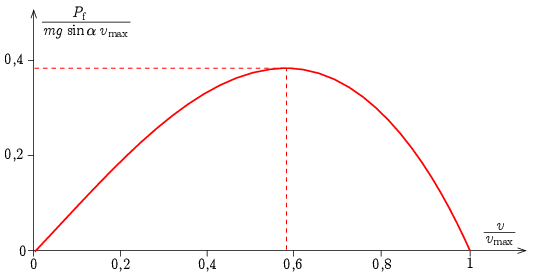
Megjegyzés. Látható, hogy a grafikonnak valahol a \(\displaystyle 0<v<v_\mathrm{max}\) tartományon maximuma van. Ez érthető, hiszen nagyon kis \(\displaystyle v\) sebességnél ugyan nagy erővel kell fékezni, de a \(\displaystyle P_\mathrm{f}=F_\mathrm{f}\,v\) miatt minimális a fékteljesítmény, a határsebességhez közeledve pedig az \(\displaystyle F_\mathrm{f}\) fékerő csökken. A maximumhelyet és a maximum értékét le lehet olvasni a grafikonról, vagy deriválással lehet meghatározni:
$$\begin{gather*} P_\mathrm{f}=mg\sin\alpha\,v_\mathrm{max}\left(\frac{v}{v_\mathrm{max}}-\left(\frac{v}{v_\mathrm{max}}\right)^3\right),\\ \frac{\mathrm{d}P_\mathrm{f}}{\mathrm{d}\left(\frac{v}{v_\mathrm{max}}\right)}=mg\sin\alpha\,v_\mathrm{max}\left(1-3\left(\frac{v}{v_\mathrm{max}}\right)^2\right)=0,\\ \left(\frac{v}{v_\mathrm{max}}\right)_\mathrm{max}=\frac{1}{\sqrt{3}}\approx 0{,}577,\\ P_\mathrm{f\,max}=mg\sin\alpha\,v_\mathrm{max}\left(\frac{1}{\sqrt{3}}-\frac{1}{3\sqrt{3}}\right)=\frac{2}{3\sqrt{3}}\,mg\sin\alpha\,v_\mathrm{max}\approx 0{,}385\cdot mg\sin\alpha\,v_\mathrm{max}. \end{gather*}$$Statistics:
25 students sent a solution. 4 points: Bense Tamás, Bogdán Balázs Ákos, Ferencz Kevin, Gombos Barna, Horváth Péter, Kossár Benedek Balázs, Lakatos Levente, Molnár Lili, Papp Emese Petra, Simon János Dániel, Tajta Sára, Tasnádi Zsófia, Vincze Anna, Zádori Gellért (14 students). 3 points: Blaskovics Ádám, Borsics Bendegúz, Wolf Erik, Zhao Aaron (4 students). 2 points: 1 student. 1 point: 2 students. 0 points: 1 student.
Problems in Physics of KöMaL, February 2026