

 Problem P. 5743. (September 2026)
P. 5743. The point-like balls of masses \(\displaystyle M\) and \(\displaystyle m_1\) attached to the ends of the equal-length pendulums shown in the figure are just touching when the strings are vertical. The pendulum carrying the mass \(\displaystyle M\) is displaced through an angle \(\displaystyle 0<\alpha\leq 90^\circ\) from the vertical and then released from rest. After the perfectly elastic collision of the two balls, the maximum angular displacement of the pendulum of mass \(\displaystyle M\) from the vertical is \(\displaystyle \Phi_1\). The ball of mass \(\displaystyle m_1\) is then replaced by another ball of mass \(\displaystyle m_2\), and the experiment is repeated under identical conditions. In this case, the maximum angular displacement of the pendulum of mass \(\displaystyle M\) from the vertical is \(\displaystyle \Phi_2\).
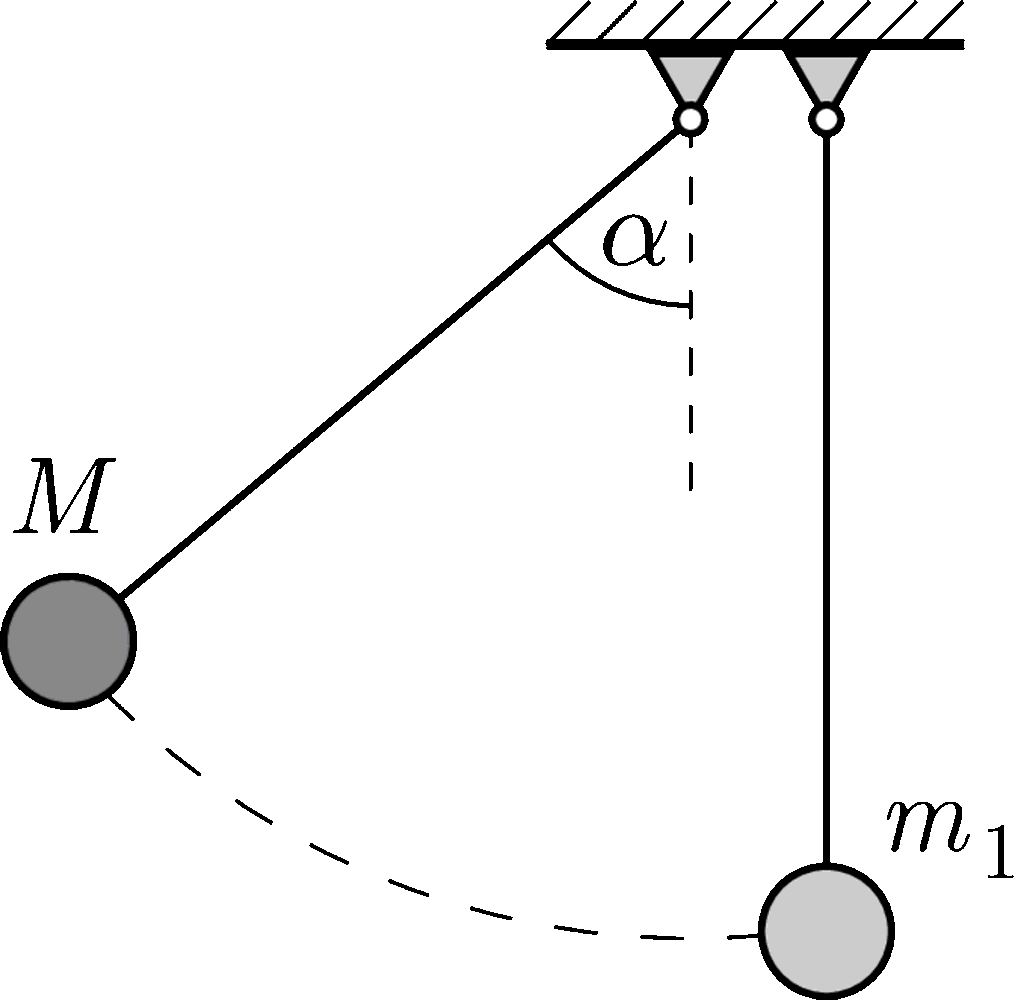
What is the relationship between \(\displaystyle \Phi_1\) and \(\displaystyle \Phi_2\) if \(\displaystyle M\) is the geometric mean of \(\displaystyle m_1\) and \(\displaystyle m_2\)?
(4 pont)
Deadline expired on October 15, 2026.
Sorry, the solution is available only in Hungarian. Google translation
Megoldás. Az első golyó ütközés előtti sebességét jelöljük \(\displaystyle v\)-vel. Az álló golyón történő rugalmas ütközés után a rugalmas ütközések Függvénytáblázatban is megtalálható képletei szerint az első golyó
\(\displaystyle v'_1=\frac{M-m_1}{M+m_1}\,v\)
sebességgel halad tovább (\(\displaystyle v'_1>0\)), vagy pattan vissza (\(\displaystyle v'_1<0\)) aszerint, hogy \(\displaystyle M\) nagyobb, vagy kisebb \(\displaystyle m_1\)-nél. Hasonlóképpen, amikor a második golyót \(\displaystyle m_2\) tömegűre cseréljük, az első golyó ütközés utáni sebessége
\(\displaystyle v'_2=\frac{M-m_2}{M+m_2}\,v\)
lesz. A két ütközés utáni sebesség aránya, közben behelyettesítve a mértani közép feltétel miatt \(\displaystyle M=\sqrt{m_1m_2}\)-t:
\(\displaystyle \frac{v_1}{v_2}=\frac{M-m_1}{M+m_1}\cdot\frac{M+m_2}{M-m_2}=\frac{\left(\sqrt{m_1m_2}-m_1\right)\left(\sqrt{m_1m_2}+m_2\right)}{\left(\sqrt{m_1m_2}+m_1\right)\left(\sqrt{m_1m_2}-m_2\right)}= \frac{\sqrt{m_1}\left(\sqrt{m_2}-\sqrt{m_1}\right)\sqrt{m_2}\left(\sqrt{m_1}+\sqrt{m_2}\right)}{\sqrt{m_1}\left(\sqrt{m_2}+\sqrt{m_1}\right)\sqrt{m_2}\left(\sqrt{m_1}-\sqrt{m_2}\right)}=-1.\)
Ha a sebességek az alsó pontban egyforma nagyok, de ellenkező irányúak, akkor a maximális kitérésekre is ugyanez teljesül:
\(\displaystyle \Phi_1=-\Phi_2.\)
Statistics:
24 students sent a solution. 4 points: Fekete Simon, Hammer Kristóf, Hicsó Máté Kristóf, Horváth Péter, József Áron, Kávrán-Kőnig Balázs, Máthé Csongor Örs, Mezei Marcell, Rajtik Sándor Barnabás, Szighardt Anna, Szilágyi Tamás, Zhao Aaron , Zsilák Márk Péter (13 students). 3 points: Araczki Ádám, Bense Tamás, Birton Richárd-Zoltán , Brassai Hunor Tihamér, Sofró Dániel (5 students). 2 points: 3 students. 0 points: 1 student.
Problems in Physics of KöMaL, September 2026