

 Problem P. 5752. (October 2026)
P. 5752. A horizontal rod is attached to a rectangular wooden block, the total mass of the block and the rod is \(\displaystyle M\). A light spring is mounted on each side of the rod; one end of each spring is attached to the block, while the other end is attached to a body of mass \(\displaystyle m_1\) and \(\displaystyle m_2\), respectively. The springs can exert both tension and compression forces. The bodies can slide without friction along the rod. The springs are deformed by means of a thread with a force \(\displaystyle F\), and the thread is then burnt. What is the minimum coefficient of friction between the wooden block and the horizontal table that ensures that the block remains at rest, regardless of the spring constants of the springs?
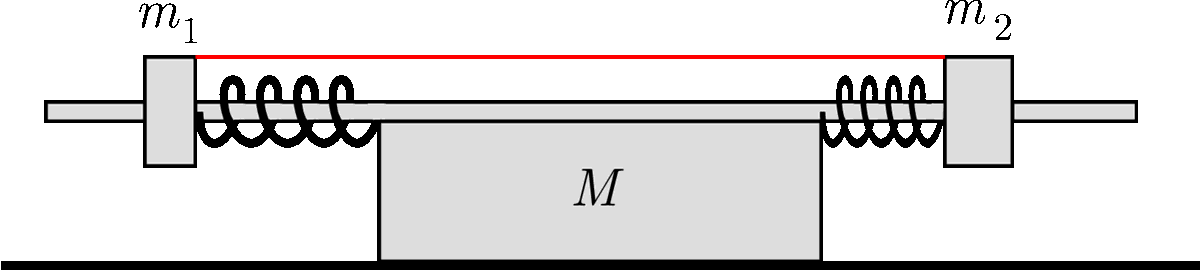
(5 pont)
Deadline expired on November 16, 2026.
Sorry, the solution is available only in Hungarian. Google translation
Megoldás. A fahasáb akkor nem mozdul meg, ha a súrlódási erő minden pillanatban elegendően nagy a mozgó testek teljes impulzusának megváltoztatásához.
Egy-egy testnek akkor a legnagyobb az impulzusváltozása, amikor a hozzá kapcsolt rugó hossza a nyújtatlan állapothoz képest minimális vagy maximális. Azonban a kezdeti állapot is ilyen: akkor mindkét rugó maximálisan összenyomott állapotban van, és ehhez \(\displaystyle F\) erőre van szükség. Tehát mindkét testre legfeljebb \(\displaystyle F\) erővel hat a rugó – és így mindkét rugó legfeljebb \(\displaystyle F\) erővel hat a fahasábra.
A testek (általánosságban) különböző frekvenciával rezegnek, így a rezgések egymáshoz viszonyított fázisa folyamatosan változik. Így (általánosságban) lesz olyan időpont, amikor a két test egyszerre kerül a rezgés szélső helyzetébe, és azonos irányba gyorsul (tehát az egyik rugó maximálisan összenyomott, a másik maximálisan megnyúlt állapotban van). Ilyenkor a fahasábra \(\displaystyle 2F\) erő hat.
A súrlódási erőnek tehát ekkora erővel kell egyensúlyt tartania, amiből a keresett minimális súrlódási együttható:
\(\displaystyle \mu\geq\frac{2F}{(M+m_1+m_2)g}.\)
Statistics:
Problem P. 5752. is not processed yet.
Problems in Physics of KöMaL, October 2026