

 Problem B. 5531. (April 2026)
B. 5531. The incenter of triangle \(\displaystyle ABC\) is \(\displaystyle I\), the circumcenters of triangles \(\displaystyle ABI\), \(\displaystyle BCI\) and \(\displaystyle CAI\) are \(\displaystyle D\), \(\displaystyle E\) and \(\displaystyle F\), respectively. Prove that the area of triangle \(\displaystyle CDE\) is at least as large as the area of triangle \(\displaystyle ABC\).
Proposed by Gábor Holló, Budapest
(5 pont)
Deadline expired on May 11, 2026.
Sorry, the solution is available only in Hungarian. Google translation
Megoldás. Legyenek a háromszög szögei a szokásos módon \(\displaystyle \alpha\), \(\displaystyle \beta\) és \(\displaystyle \gamma\), a körülírt kör sugara pedig \(\displaystyle r\). Jól ismert, hogy a \(\displaystyle D\), \(\displaystyle E\), \(\displaystyle F\) pontok a körülírt körön a csúcsokkal szemközti \(\displaystyle \widehat{BC}\), \(\displaystyle \widehat{CA}\), \(\displaystyle \widehat{AB}\) íveinek felezőpontjai. (Lásd például a B. 5291. feladat megoldását, vagy az angol nyelvű irodalomban az incenter-excenter lemmát.)
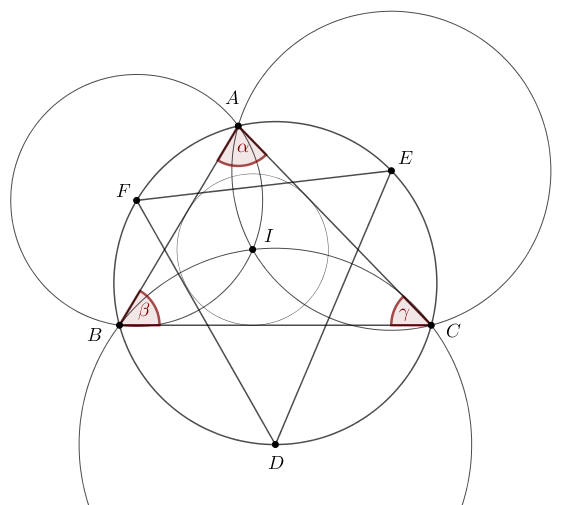
A \(\displaystyle \widehat{BC}\), \(\displaystyle \widehat{CA}\), \(\displaystyle \widehat{AB}\), \(\displaystyle \widehat{EF}\), \(\displaystyle \widehat{FD}\), \(\displaystyle \widehat{DE}\) ívek középponti szöge rendre \(\displaystyle 2\alpha\), \(\displaystyle 2\beta\), \(\displaystyle 2\gamma\), \(\displaystyle \beta+\gamma\), \(\displaystyle \gamma+\alpha\), illetve \(\displaystyle \alpha+\beta\), így
\(\displaystyle BC=2r\sin\alpha, \quad CA=2r\sin\beta, \quad AB=2r\sin\gamma, \)
\(\displaystyle EF=2r\sin(\beta+\gamma), \quad FD=2r\sin(\gamma+\alpha), \quad DE=2r\sin(\alpha+\beta). \)
Az \(\displaystyle t=\dfrac{abc}{4r}\) területképletet felírva a két háromszögre,
\(\displaystyle t_{ABC} = \dfrac{BC\cdot CA\cdot AB}{4r} = 2r^2\cdot\sin\alpha\cdot\sin\beta\cdot\sin\gamma \)
és
\(\displaystyle t_{DEF} = \dfrac{EF\cdot FD\cdot DE}{4r} = 2r^2 \cdot\sin\frac{\beta+\gamma}2 \cdot\sin\frac{\gamma+\alpha}2 \cdot\sin\frac{\alpha+\beta}2, \)
tehát azt kell igazolnunk, hogy
| \(\displaystyle \sin\alpha\cdot\sin\beta\cdot\sin\gamma \le \cdot\sin\frac{\beta+\gamma}2 \cdot\sin\frac{\gamma+\alpha}2 \cdot\sin\frac{\alpha+\beta}2. \) | \(\displaystyle (1) \) |
Ennek bizonyításához vegyük észre, hogy a számtani-mértani közepek és a \(\displaystyle \sin x+\sin y=2\sin\frac{x+y}2\cos\frac{x-y}2\) azonosság felhasználásával
| \(\displaystyle \sqrt{\sin\alpha\sin\beta} \stackrel{\text{}}\le \frac{\sin\alpha+\sin\beta}{2} = \sin\frac{\alpha+\beta}2\cdot\cos\frac{\alpha-\beta}2\cdot \le \sin\frac{\alpha+\beta}2, \) | \(\displaystyle (2) \) |
és egyenlőség csak \(\displaystyle \alpha=\beta\) esetén áll fenn.
Ugyanígy kaphatjuk, hogy
| \(\displaystyle \sqrt{\sin\beta\sin\gamma} \le \sin\frac{\beta+\gamma}2 \) | \(\displaystyle (3) \) |
és
| \(\displaystyle \sqrt{\sin\gamma\sin\alpha} \le \sin\frac{\gamma+\alpha}2, \) | \(\displaystyle (4) \) |
és egyenlőség csak akkor áll, ha \(\displaystyle \beta=\gamma\), illetve \(\displaystyle \gamma=\alpha\).
A \(\displaystyle (2)-(4)\) egyenlőtlenségek szorzata éppen a bizonyítandó \(\displaystyle (1)\); azt is látjuk, hogy az \(\displaystyle (1)\)-ben egyenlőség csak a szabályos háromszög esetén lép fel.
Statistics:
35 students sent a solution. 5 points: Ali Richárd, Bao Nguyen Gia, Bodor Ádám, Diaconescu Tashi, Hajba Milán, Hideg János, József Áron, Li Mingdao, Maróti Olga, Papp Mátyás, Pázmándi József Áron, Péter Hanna, Rajtik Sándor Barnabás, Sajter Klaus, Sánta Gergely Péter, Sha Jingyuan, Varsányi Benedek, Vincze Marcell, Wiener Marcell. 4 points: Benedek Olivér , Ercse Ferenc, Gaál Gergely, Gál Mózes, Hajszter Dóra, Lovas Márk, Miszori Márton, Sógor-Jász Soma, Várhegyi Hanna. 3 points: 2 students. 2 points: 2 students. 1 point: 1 student. 0 point: 2 students.
Problems in Mathematics of KöMaL, April 2026