

 Problem P. 5599. (November 2024)
P. 5599. The shape of a thin metal cup is a paraboloid of revolution, and it has a vertical axis of symmetry and is attached to a horizontal supporting plate at its apex \(\displaystyle O\). The distance between point \(\displaystyle P\) and the plate is \(\displaystyle h_0\). A point-like body is dropped into the thin tube placed inside the cup at its end point \(\displaystyle Q\), and it leaves the tube at point \(\displaystyle P\). The difference in height between the points \(\displaystyle Q\) and \(\displaystyle P\) is \(\displaystyle H\). (See the figure.)
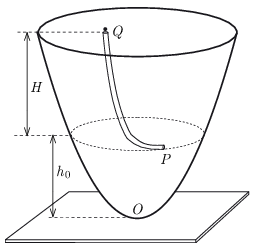
The small body flies out of the tube in the direction of a horizontal straight line, which lies in the plane tangent to the surface of the cup. Within what limits will the distance \(\displaystyle h\) of the small body from the cup vary during the rest of the motion? (Friction is negligible everywhere.)
(5 pont)
Deadline expired on December 16, 2024.
Sorry, the solution is available only in Hungarian. Google translation
Megoldás. A kis test \(\displaystyle v_0=\sqrt{2gH}\) sebességgel hagyja el a csövet a \(\displaystyle P\) pontnál. Legyen a \(\displaystyle P\) pont távolsága a szimmetriatengelytől \(\displaystyle r_0\), a lemeztől mért távolsága pedig \(\displaystyle h_0\). Mivel a felület forgási paraboloid, fennáll, hogy
| \(\displaystyle (1)\) | \(\displaystyle h_0=kr_0^2,\) |
ahol \(\displaystyle k\) egy állandó.
Abban a helyzetben, ahol a test \(\displaystyle h\) magassága maximális vagy minimális, a függőleges irányú sebességkomponens nulla, és így a szimmetriatengely felé mutató ,,radiális'' sebesség is nulla. A test sebessége tehát ebben a pontban ,,érintő irányú''. Ha a kérdéses pontban a tengelytől mért távolság \(\displaystyle r\), akkor a test magassága
| \(\displaystyle (2)\) | \(\displaystyle h=kr^2.\) |
A perdületmegmaradás törvénye szerint
| \(\displaystyle (3)\) | \(\displaystyle mr_0v_0=mrv,\) |
az energiamegmaradás törvénye szerint pedig fennáll:
| \(\displaystyle (4)\) | \(\displaystyle \frac{1}{2}mv_0^2+mgh_0=\frac{1}{2}mv^2+mgh.\) |
A (4) egyenlet
\(\displaystyle \frac{1}{2}\left(v_0^2-v^2\right)=g\left(h-h_0\right)\)
alakját (1) (2) és (3)-ból kapható \(\displaystyle v^2=v_0^2\frac{h_0}{h}\) összefüggés felhasználásával így is felírhatjuk:
\(\displaystyle \frac{v_0^2}{2}\left(h-h_0\right)=\left(h-h_0\right)gh.\)
Mivel a triviális \(\displaystyle h=h_0\) esettől különböző megoldást keresünk, egyszerűsíthetünk \(\displaystyle (h-h_0)\)-lal:
\(\displaystyle \frac{v_0^2}{2}=gh,\)
vagyis
\(\displaystyle h=\frac{v_0^2}{2g}=H.\)
A kis test távolsága tehát \(\displaystyle H>h_0\) esetén \(\displaystyle h_0\le h\le H\) értékek között változik, \(\displaystyle H<h_0\) esetben pedig \(\displaystyle H\le h\le h_0\).
Megjegyzés. Ha \(\displaystyle H=h_0\), akkor a test körpályán, egyenletes körmozgással kering. Ezt a mozgásegyenletből is megkaphatjuk. A serleg által kifejtett \(\displaystyle \boldsymbol{N}\) nyomóerő függőleges komponense
\(\displaystyle N_2=mg,\)
hiszen a test függőleges irányban nem gyorsul.
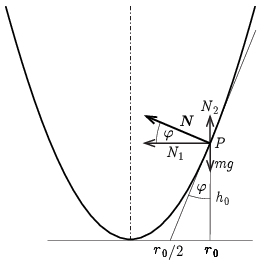
Az ábrán látható hasonló derékszögű háromszögek oldalaránya megegyezik:
\(\displaystyle \frac{N_1}{N_2}=\frac{2h_0}{r_0},\)
vagyis
\(\displaystyle N_1=\frac{2h_0}{r_0}mg.\)
Ez az erő akkor tud létrehozni \(\displaystyle r_0\) sugarú körpályán egyenletes, \(\displaystyle v_0\) sebességű körmozgást, ha
\(\displaystyle \frac{mv_0^2}{r_0}=mg\frac{2h_0}{r_0},\)
vagyis
\(\displaystyle v_0^2=2gh_0=2gH,\)
azaz \(\displaystyle H=h_0\).
Statistics:
15 students sent a solution. 5 points: Csiszár András, Kovács Tamás, Masa Barnabás, Molnár Lili, Molnár Zétény, Tóthpál-Demeter Márk, Ujvári Sarolta. 4 points: Agócs Zoltán, Kis Boglárka 08. 3 points: 2 students. 2 points: 2 students. Not shown because of missing birth date or parental permission: 1 solutions.
Problems in Physics of KöMaL, November 2024