Fórum: quadrilateral
Játékszabályok Technikai információ TeX tanfolyam Elfelejtettem a jelszavam Témák
| [6] Peter Erben | 2022-01-14 11:20:32 |
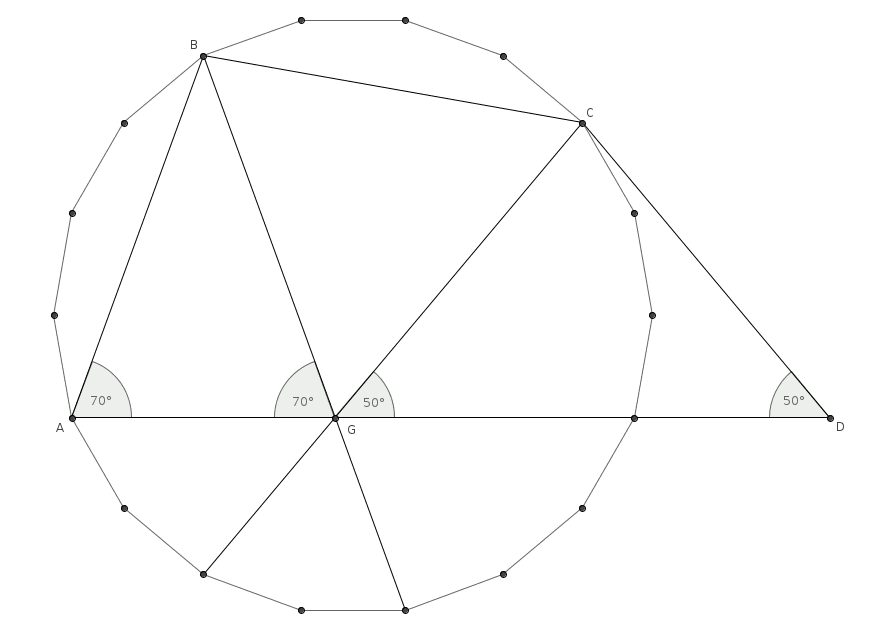
 The motivation for the previous solution was a property of the diagonals of a regular 18-gon: their angle is always a multiple of \(\displaystyle 10 ^\circ\).
Also, we can choose three of these diagonals in many ways so that the three chosen diagonals are concurrent.
|
 |
| Előzmény: [5] Peter Erben, 2022-01-14 11:08:41 |
|
| [5] Peter Erben | 2022-01-14 11:08:41 |
|
Nice solution.
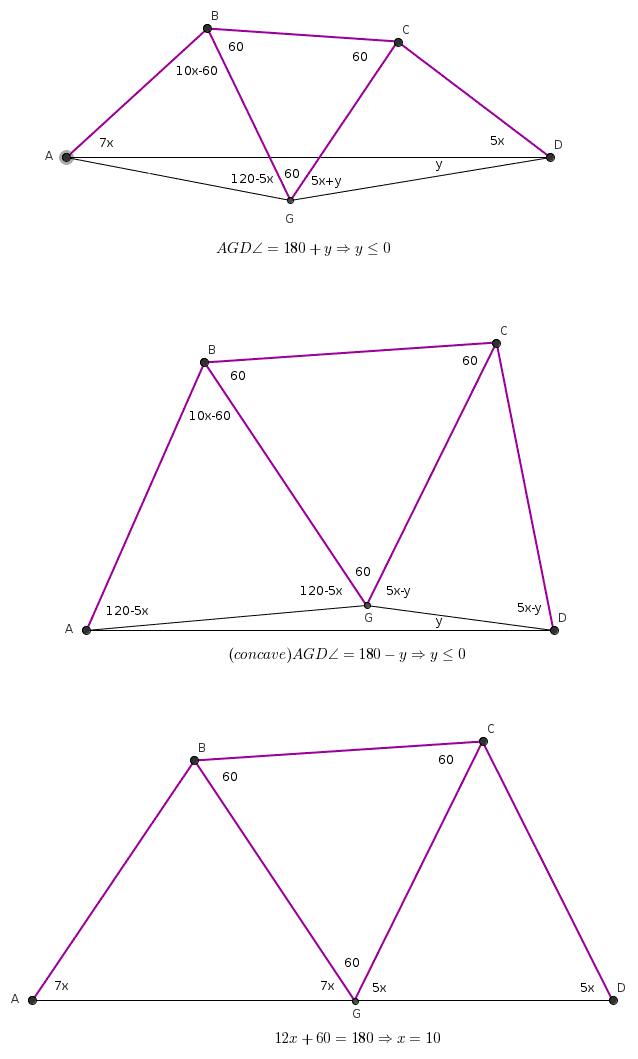
Another approach could be to draw a \(\displaystyle BCG\) equilateral triangle and prove by contradiction that \(\displaystyle G\) should line on the segment \(\displaystyle AD\).
|
 |
| Előzmény: [4] Lpont, 2022-01-13 22:53:04 |
|
| [4] Lpont | 2022-01-13 22:53:04 |
 The bisector of section AC intersects section AD at E, and the bisector of section BD intersects section AD at F (ABCD is a convex quadrilateral).
Due to AB=BC=CD, the ABCE and the BCDF quadrilaterals are deltoids, FBC angle is 5x and EBC angle is also 10x/2=5x. E is the same F because both points lie on the segment AD. Hereinafter, the notation E is used.
Then AEB angle = BEC angle = CED angle = 60, hence 7x + 5x = 12x in the ABE triangle = 120. There is x = 10 and in the convex quadrilateral ABCD the angle at C is 360-22x = 140.
The triangles ABE, BEC, and CED are congruent, with angles of 50, 60, and 70, respectively.
|
| Előzmény: [3] perash, 2022-01-13 19:36:30 |
|
|
|
| [1] perash | 2022-01-11 21:22:59 |
|
Given a convex quadrilateral \(\displaystyle ABCD \) with \(\displaystyle AB = BC = CD \) and \(\displaystyle m(\angle DAB) = {7x }\),\(\displaystyle \,m(\angle A BC) = {10x }\), \(\displaystyle m(\angle CDA) = { 5x }\), Find \(\displaystyle m(\angle BCD) \).
|
|
Játékszabályok Technikai információ TeX tanfolyam Elfelejtettem a jelszavam Témák